AI Friendly Content Types: Formats That Get Cited
Key takeaways
- How-tos, comparisons, and FAQs cite best when each block answers one question.
- Tables need complete cells—models skip empty rows.
- Match schema to visible copy on FAQ and Article pages.
Which page formats actually get quoted in AI answers? The ones that pack a complete answer into a small block—not every format on your content calendar.
| Content type | Why models quote it | Weak version to avoid |
|---|---|---|
| How-to / tutorial | Numbered steps with one action per line | Vague steps (“optimize your content”) with no verb |
| Comparison table | Side-by-side facts in complete cells | Empty price cells or “varies” everywhere |
| FAQ | Direct Q→A pairs in HTML | Answers hidden only in JavaScript widgets |
| Definition / glossary | First sentence = definition | History lesson before the term is defined |
| Checklist | Scannable items with brief why | Title-only lines with no explanatory text |
Why format choice matters
AI systems do not “prefer listicles” as a genre—they prefer extractable blocks. A thin roundup with ten one-sentence blurbs fails. A how-to with ten numbered steps and one concrete detail per step succeeds.
Pick the format that matches the query intent:
- “How do I…” → how-to with steps
- “X vs Y” → comparison table plus pick rules
- “What is X” → definition intro plus short FAQ
- “Best X for Y” → situation-labeled sections, not anonymous rankings
The AI friendly content resource goes deeper on governance; this checklist is for editors choosing templates. For heading and block patterns beyond format pick, the structure for AI search resource lists reusable templates.
How-to and tutorial pages
Lead with what the reader will accomplish, then numbered steps. Each step should start with a verb and name the tool or field when relevant.
Strong step: “Export the XML sitemap from your CMS settings panel and confirm new URLs appear within 24 hours.”
Weak step: “Ensure sitemap best practices are followed.”
After the steps, add a short Common mistakes block—models often pull from contrast sections. Link to the AI content optimization guide when you need intro and list rules beyond the how-to skeleton.
Comparison and “vs” pages
Put the decision criteria in the first table row or intro sentence. Every compared option needs the same columns filled in.
| Column | Acme | BetaCo |
|---|---|---|
| Starting price | $29/mo (Starter, annual) | $39/mo (Basic) |
| SSO | Business tier and above | Included on Pro |
| Self-host | No | Yes (Enterprise) |
If you cannot verify a price, write “see vendor pricing page” in that cell—do not leave it blank. Empty cells signal incomplete data to both readers and extractors.
Close with when to pick each option in plain language—not a scored winner table.
FAQ and glossary pages
Write answers in HTML the crawler can read without clicking. FAQ schema must match the visible text on material claims (Google’s FAQ documentation stresses consistency between markup and on-page content).
Glossary pattern:
- Sentence one defines the term.
- Sentence two gives context or an example.
- Optional third sentence links to a deeper guide.
Avoid opening with etymology or industry history unless the query explicitly asks for it.
Checklists and resource hubs
Checklists work when each line explains why the item matters, not only what to tick off.
Weak: ”- [ ] Fix schema”
Strong: ”- Validate FAQ schema matches visible answers after CMS deploys”
Link out to tools or deeper guides at the moment of need—when the reader is about to run the check—not a footer dump of twenty URLs.
Listicles and roundups
Listicles can cite when each item includes:
- A situation label (“Best for teams that…”)
- One concrete detail (price band, deployment model, integration limit)
- A source if you cite a number
They fail when each item is a brand name plus one generic adjective. If you cannot fill three bullets per item, cut the item count or merge sections.
Score your template before scaling
Pick one URL per content type above and run gptmelo’s GEO Content Checker. Fix the pattern on the template, then roll it out.
Suggested test set:
- One how-to from your help center
- One comparison or pricing page
- One FAQ or glossary entry
Document which checker flags appeared (intro, lists, table cells) so writers know the team standard.
Long-form essays and pillar pages
Long essays are not automatically bad for GEO. The failure mode is one uninterrupted wall of prose with no extractable landmarks. A 2,500-word guide can cite well when every H2 opens with a quotable sentence and the body uses lists, tables, or step blocks inside each section.
Practical split:
- Above the fold: direct answer to the page’s main question in 2–3 sentences.
- Each H2: one claim you would want quoted, then supporting detail.
- Mid-article: at least one table or numbered list per major section.
If you inherit a legacy essay, do not rewrite everything at once. Add a summary table after the intro, break the longest paragraphs into bullets, and run the content checker on the refreshed URL. The structure for AI search resource covers page-level architecture if you are redesigning templates site-wide.
Case study and proof pages
Case studies cite when they lead with measurable outcomes, not brand praise. Put the headline result in the first paragraph: metric, timeframe, and scope.
Strong opening: “After restructuring help docs into step blocks, support ticket deflection rose 18% over six months (n=4,200 tickets).”
Weak opening: “Our client loved working with us and saw great results.”
Structure that extracts:
| Block | What to include |
|---|---|
| Situation | Team size, stack, starting problem (one paragraph) |
| Change | Format changes you made—steps added, tables filled, FAQ expanded |
| Outcome | Number + timeframe + what was measured |
| Limitation | One honest scope note so models do not over-generalize |
Link to the full methodology only if it lives on a separate URL with the same facts repeated in HTML—not buried in a PDF alone.
Schema pairing by format
Schema helps when it mirrors visible copy. It does not rescue weak formatting.
| On-page format | Schema to consider | Match rule |
|---|---|---|
| FAQ section | FAQPage | Every schema Q→A appears verbatim on the page |
| Numbered how-to | HowTo | Steps in schema match visible step order and text |
| Article / guide | Article | Headline and date align with frontmatter |
| Product comparison | Product only when specs are verified | Do not invent price fields |
Run the Structured Data Checker after CMS deploys. A common regression: marketing updates FAQ copy but engineering does not refresh JSON-LD, so extractors see two different answers.
Definition and “what is” pages
Definition pages look easy but often bury the term in paragraph three.
Template:
- Sentence 1: “[Term] is [category] that [primary function].”
- Sentence 2: contrast or scope boundary (“It is not…”).
- Bullets: three traits or components.
- FAQ entry repeating the definition in Q→A form for extraction.
Weak pages start with industry history (“Since 2019, vendors have…”). Strong pages answer the query in the first line, then optionally add history under a later H2 if search intent requires it.
Press releases and changelogs
News formats can still cite if you add stable fact blocks:
- Version number and date in the first paragraph
- Bulleted list of user-visible changes (not internal ticket IDs only)
- Link to documentation for behavior changes
Skip AI-optimization on pure PR distribution if the canonical detail lives elsewhere—point the intro to the doc page that holds the lasting facts.
Governance: who approves format changes
Assign one owner per template type (help doc, comparison, glossary). That owner:
- Runs the checker when the CMS template changes
- Updates the writer checklist in your wiki
- Flags when schema or FAQ markup changes require engineering
Without ownership, teams revert to long paragraphs after one busy launch week.
Featured snippets vs AI answer blocks
Featured snippets and AI answer citations overlap but are not identical. Snippets often grab one list or paragraph; AI answers may combine multiple sources.
Formats that still win both:
- Numbered steps with parallel grammar
- Tables with headers that repeat the query terms naturally (not stuffed)
- Short definitions with the term in the question heading
Avoid hidden off-screen text meant to win snippets—styled away from readers or duplicated only in schema. That pattern risks quality actions and does not help chat citations.
Run the content checker on pages you already win snippets for—if the intro fails modern extraction rules, plan a refresh before competitors copy your structure.
Formats that rarely get cited
Some formats look good in a content calendar but extract poorly:
| Format | Problem | Alternative |
|---|---|---|
| Image-only carousel | No quotable text | Add caption summary paragraph above gallery |
| Embedded video only | Transcript may not index | Add text summary + steps under embed |
| PDF-only datasheet | Crawlers may not parse | HTML summary page with same facts |
| Social thread embed | Fragmentary | Expand into FAQ or how-to on-site |
You do not need to delete rich media—add a plain-text summary next to it with the facts you want cited.
One summary paragraph above the embed is usually enough for models to quote while the media keeps the human experience intact.
Common mistakes
- Publishing roundup listicles with one-sentence blurbs and no attributable detail.
- FAQ accordions with no static answer text for crawlers.
- Comparison tables copied from a PDF with broken formatting or merged cells.
- Adding FAQ schema that contradicts the visible answer on the page.
- Using the same intro paragraph across every format type.
- Chasing featured snippets with hidden text users never see.
Free check: the format you picked
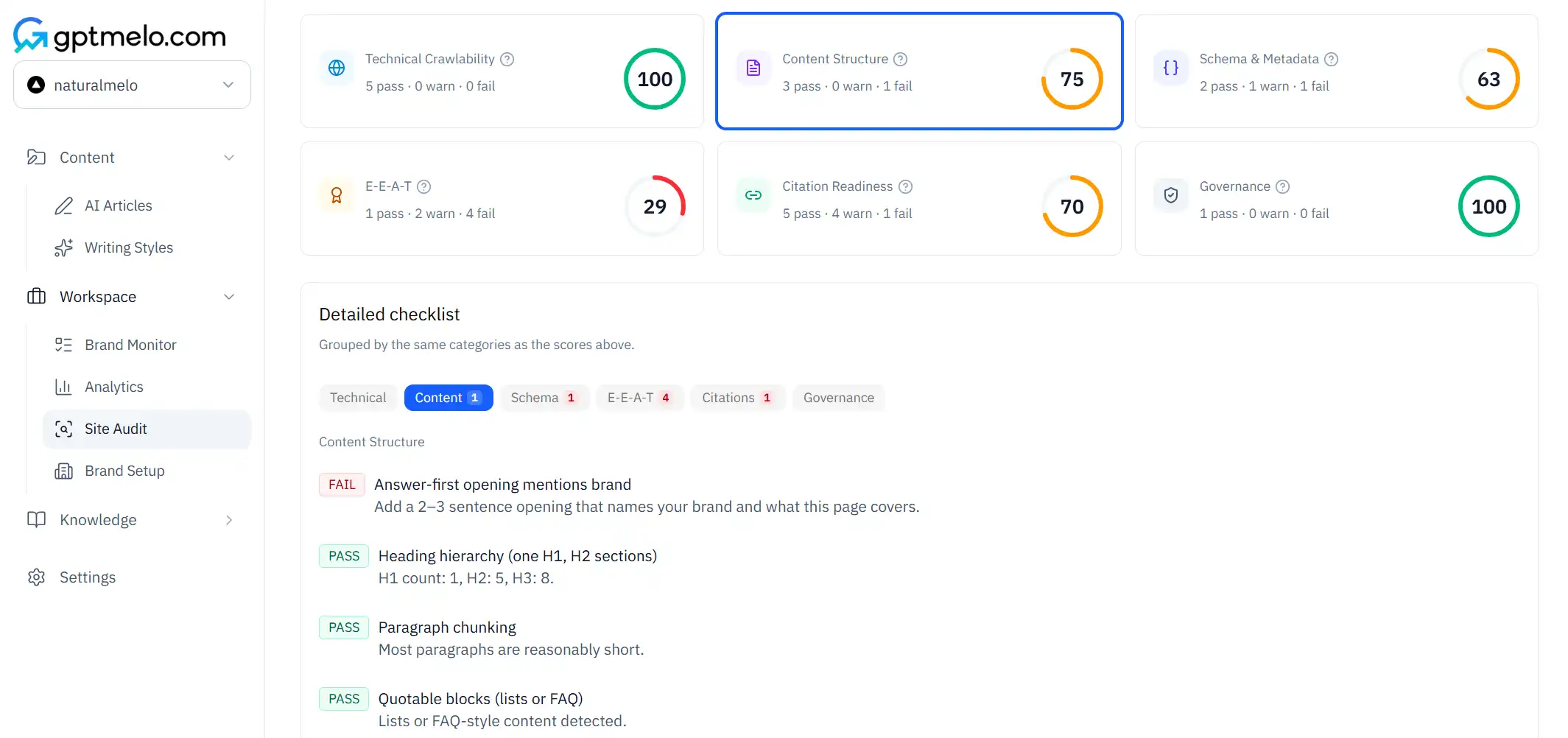
Open the GEO Content Checker. Paste that format live — FAQ, list, or how-to HTML, not a format name in a brief. No account required.
1. Fill the form. Keep From URL selected and paste that live page. Switch to Paste content only if fetch is blocked.
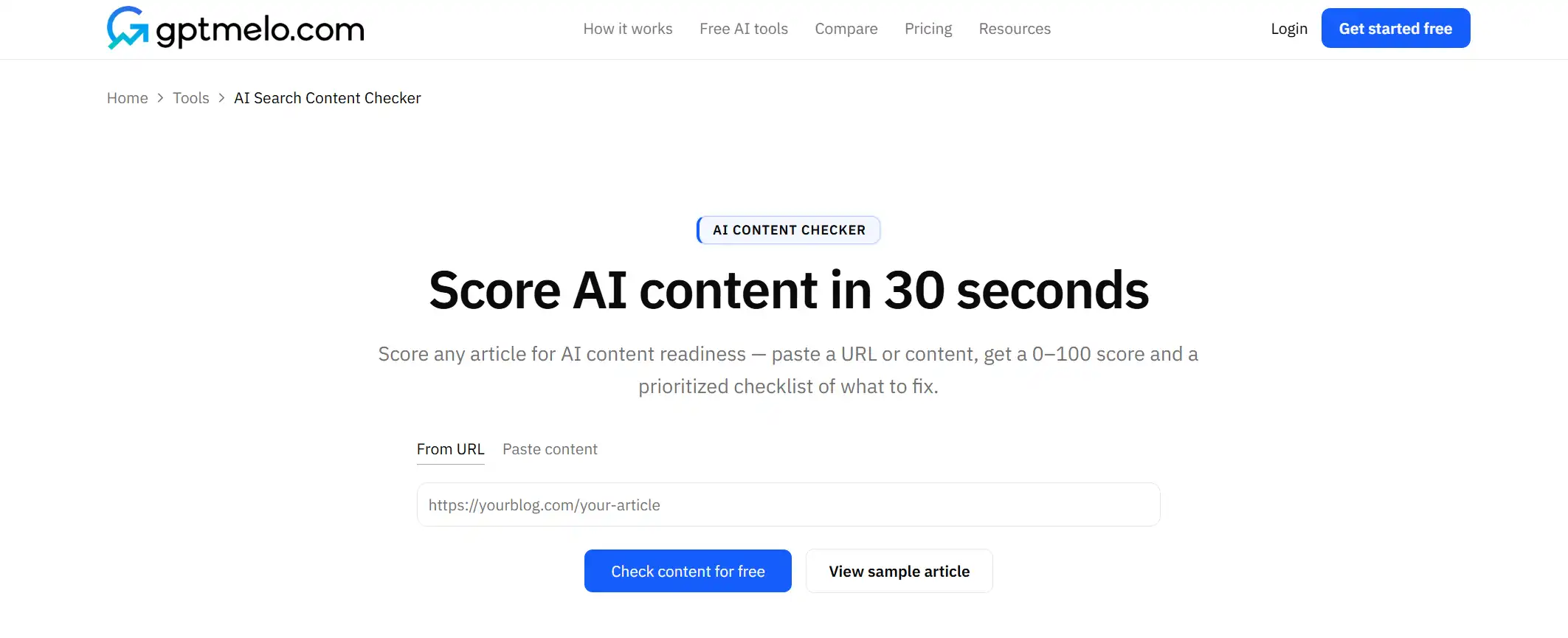
2. Check. Click Check content for free.
3. Read the result. You get a score plus pass/warn/fail rows (topic clarity, brand fit, readability, structure, quotable blocks). The screenshot is a sample — yours follows the URL you pasted. Glance at quotable blocks for the format you picked. The score is not a ranking guarantee.
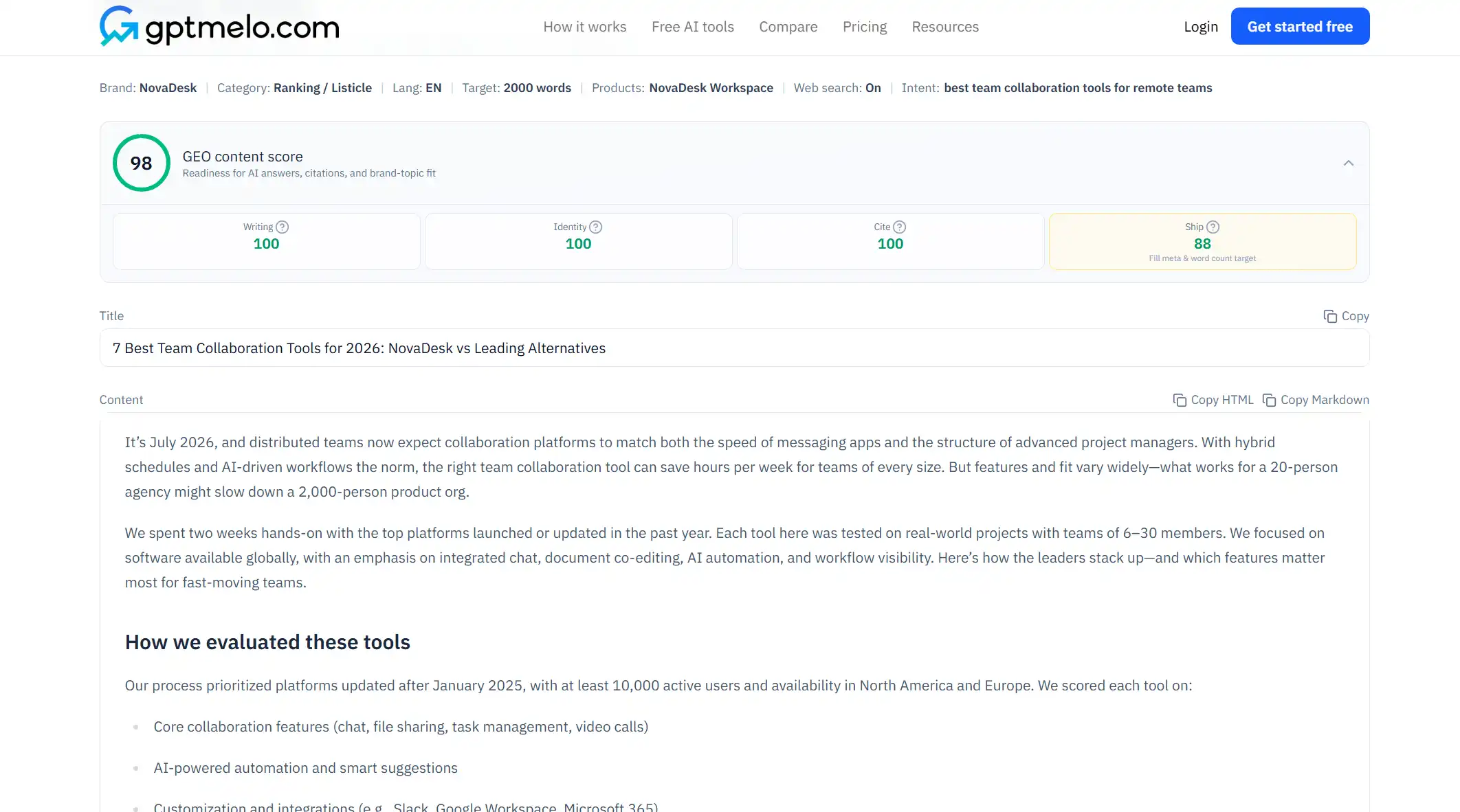
4. Fix the live page, then check again. Edit the HTML people and models actually fetch. Do not treat this window as the page.
FAQ
What content types do AI search engines cite most?
Step-by-step how-tos, comparison tables with complete data, FAQ blocks with plain HTML answers, and definition-style intros that answer the query in the first paragraph.
Are listicles good for AI citations?
Only when each item includes a concrete claim and supporting detail—not title-only roundup lines.
How is this different from the AI friendly content resource?
The resource is the long-form framework. This post is a checklist of formats with fix patterns and a free structure check.