
AI Content Optimization: Structure Pages for AI Citations

Key takeaways
- AI systems extract quotable blocks—structure beats keyword stuffing.
- Lead with a direct answer in the first 100 words.
- Run a free structure check before publish.
What is AI content optimization? It is the work of shaping a page so an AI system can lift a paragraph, list, or table row into an answer—without rewriting the whole site for one model. Lead each major section with the claim you would want quoted, then support it with one list or attributed fact.
| Situation | I’d prioritize | Skip if |
|---|---|---|
| Evergreen guide or how-to | Intro answers in sentence one, then a list or table | You only chase keyword density |
| Comparison or pricing page | Complete table cells with numbers and sources | Cells are blank or say “contact sales” |
| Localized content | Same structure per locale plus hreflang | You need playful prose that resists chunking |
| New product launch | FAQ block plus attributed specs | Every claim sits behind a login |
Why structure matters more than density
Retrieval systems chunk pages into small blocks. A buried answer in paragraph four rarely ships. A numbered list under a clear H2 often does.
Google’s helpful content guidance still rewards pages that satisfy intent quickly. AI answers amplify that—models prefer blocks they can quote without editing. Keyword repetition without a scannable structure helps neither humans nor extractors.
Think in blocks, not word count targets: one direct answer, one supporting list, one table or FAQ pair per major claim. That pattern maps cleanly to how Overviews and chat tools assemble responses.
Step 1: Write the intro as the answer
Open with the conclusion, not the history.
Weak: “AI content optimization is an important trend in digital marketing.”
Strong: “AI content optimization means leading each section with the claim a reader would quote, then supporting it with one attributed stat or example.”
Read the intro aloud. If it sounds like a press release lede, shorten it. The first 100 words should stand alone if a model only sees that chunk.
For a pricing page, the intro might be: “Acme Pro costs $49 per seat per month as of August 2026 and includes SSO; the free tier caps at three seats.” That is more citable than three adjectives about “innovative pricing.”
Step 2: Add list blocks and tables after each major claim
After every H2 that makes a claim, add:
- Three to seven bullets with parallel grammar, or
- A table with complete cells (no em dashes pretending to be data)
Example transformation:
Before: One long paragraph mixing benefits, features, and a vague stat.
After: Sentence one states the benefit. Bullets name features. A final line cites the stat with a source.
Comparison pages need the same discipline—if you are weighing Surfer-style SEO optimizers, validate extractable blocks with the gptmelo vs Surfer comparison, not keyword density alone.
For step-by-step workflows, use numbered lists with one verb per line (“Export the sitemap”, not “Sitemap considerations”). Link the AI search optimization tools roundup when you need the checker stack; keep the steps on this page about shape, not vendor picks.
Step 3: Attribute stats and dates
Replace “studies show” with a named source and year when you have one. If you do not have a source, describe the observation without inventing a percentage.
Examples that work:
- “Google’s documentation on FAQ structured data requires visible answers to match schema markup.”
- “Semrush’s public AI search materials recommend extractable FAQ blocks for product and comparison pages.”
Examples that fail:
- “Research shows 60% faster indexing” with no link.
- “One SaaS company doubled traffic” with no named company or method.
When you cite a vendor doc, add as of [[MONTH_YEAR]] if the detail can change (pricing, feature flags, bot names).
Step 4: Align FAQ and schema with visible HTML
FAQ sections are high-value extraction targets—when they are real HTML, not only accordion JavaScript.
Checklist:
- Each question is an H3 or explicit FAQ heading.
- The answer text appears in the DOM without a click.
- FAQ schema matches the visible answer on factual claims.
- No contradiction between schema and body (a common fail after CMS updates).
Run the Structured Data Checker on a template URL after you change FAQ markup. Fix schema before you scale to hundreds of URLs.
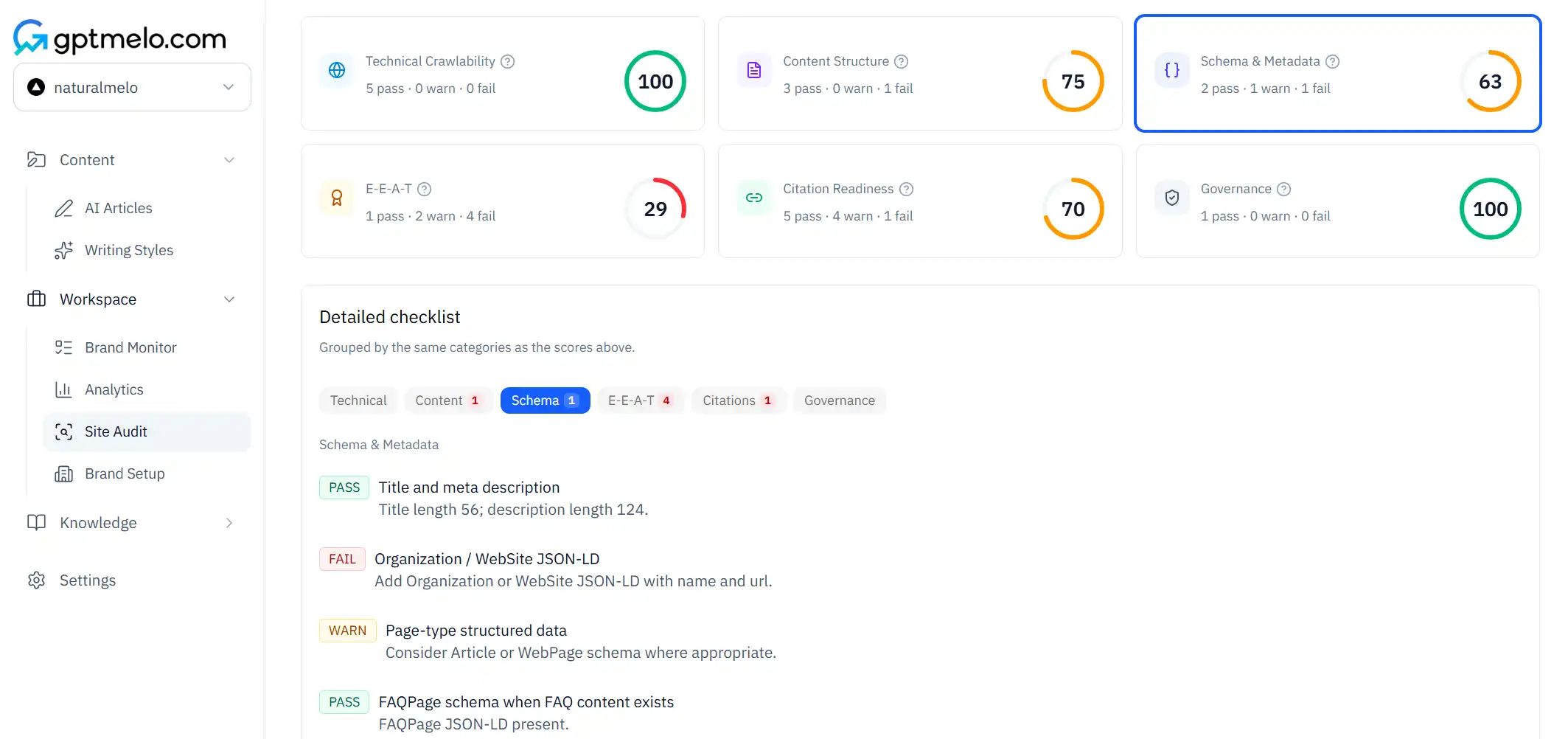
Step 5: Score the draft before publish
Paste the URL or text into the GEO Content Checker. Fix flagged sections—usually the intro, missing lists, or paragraphs longer than a short email.
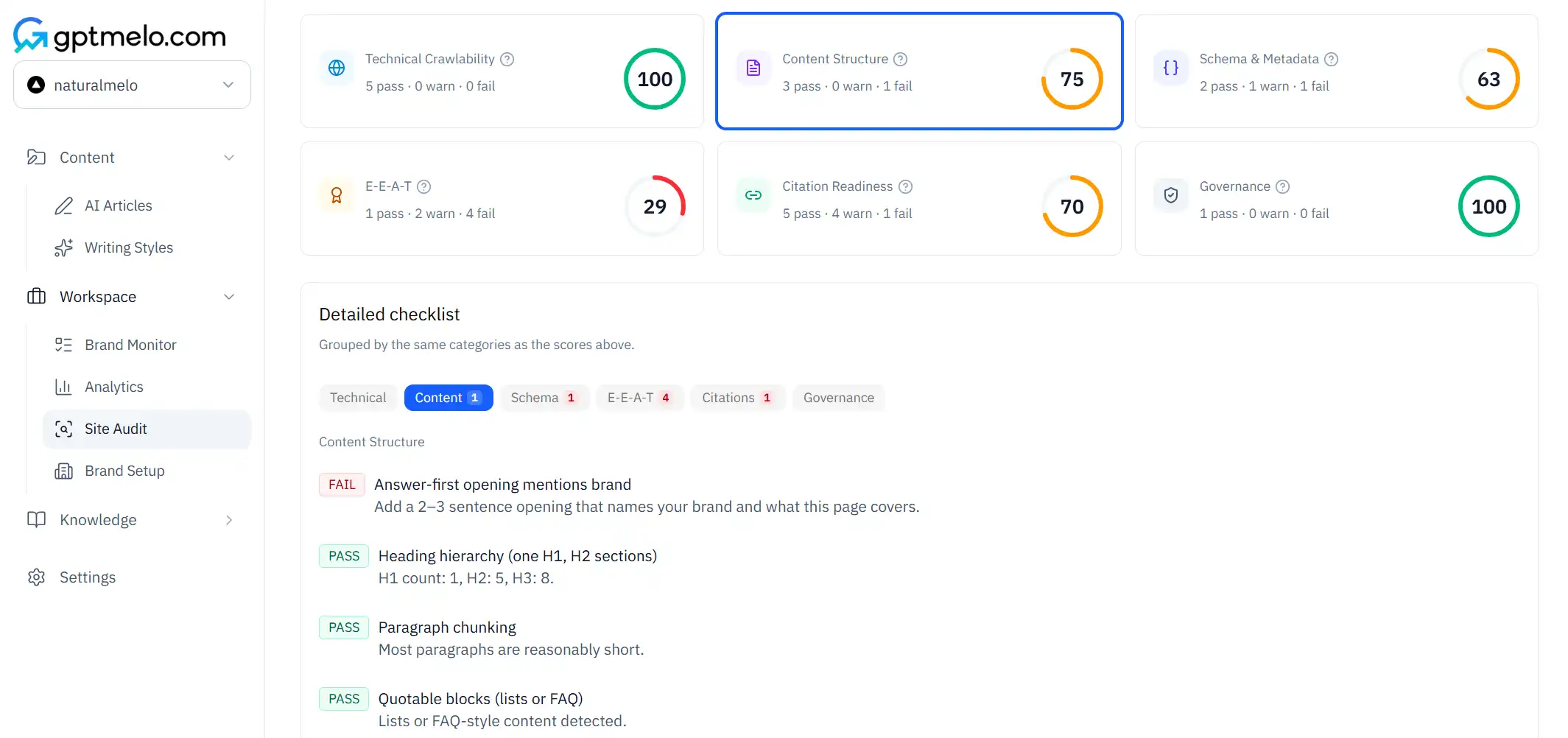
Typical fix order:
- Intro fails → rewrite as direct answer + list.
- Mid-page fails → split wall-of-text into claim + bullets.
- Table fails → fill empty cells or remove the row.
Pair this pass with the get cited by AI resource for governance and team workflow. For ChatGPT drafting workflows, see ChatGPT for content generation.
Step 6: Maintain templates, not one-off hero pages
The highest ROI is a template that passes the checker—product detail, comparison, glossary—not polishing a single blog post while leaving fifty SKUs untouched.
Workflow:
- Pick the URL type that drives revenue or support tickets.
- Optimize that template until the checker passes.
- Document the pattern in your CMS (required blocks: intro answer, list, source line).
- Re-check after major CMS or theme releases.
For the full write→score→publish loop in one workspace, see how GEO article writing works.
Editors then spend time on facts and examples, not re-learning structure rules per article.
Ten-step checklist
Use this sequence on a single priority URL before you roll the pattern out site-wide. It condenses the full checklist into one pass.
- State the query in the reader’s words in the intro’s first sentence.
- Add a scannable block (list or table) within the first two screenfuls.
- Break walls of text — no paragraph longer than ~120 words without a list.
- Name the author on trust-sensitive pages; link to a real profile where possible.
- Date the page with a visible updated line when facts change often.
- Attribute every stat — source name and year, or drop the number.
- Render FAQ in HTML — not only inside JS accordions.
- Match FAQ schema to visible answers on factual claims.
- Fill comparison tables — same columns for every row.
- Run the GEO Content Checker — fix the biggest gaps first, then re-run.
Steps 1–3 are editorial; 4–6 are trust; 7–9 are template markup; 10 confirms you did not miss a structural gap. For the checker stack beyond structure, see the tools roundup linked in Step 2.
Entity clarity and author signals
AI answers often attribute claims to a brand or author. Make both easy to extract:
- Brand — consistent legal name in title, H1 (rendered from frontmatter), and footer
- Author — byline on guides; link to bio with role and scope
- Organization — logo alt text and Organization schema where appropriate
- Scope — say what the page covers and what it deliberately excludes (without self-defense tone)
The EEAT Checker flags missing trust signals on a URL; pair it with human review on YMYL topics.
Internal links for extraction
Internal links help readers and models route to deeper answers. Rules that work for AI-friendly sites:
- Link at the moment of need (“validate schema” → Structured Data Checker or a related guide)
- Use topic anchors, not naked paths
- Same destination at most twice per article unless the intent differs
- Other blog posts use
/blog/posts/{slug}/paths
Do not dump a link farm at the bottom—models and readers both skip footer sitemaps masquerading as prose.
AI Overviews and chat: shared patterns
Google’s AI features in Search and standalone chat tools share extraction habits even when ranking signals differ. Patterns that travel well:
- Direct answer first — the first sentence should survive if everything else is stripped away
- Lists beat prose for procedural queries (“how to”, “steps to”, “checklist for”)
- Tables beat adjectives for comparison queries (“vs”, “alternative”, “pricing”)
- Stable URLs — major rewrites without redirects break citations others already picked up
When you optimize for AI Overviews, you are still optimizing for quotable blocks, not a separate keyword universe. The AI SEO vs SEO resource clarifies where workflows diverge; this section stays on on-page shape.
Measuring progress without fake metrics
Skip invented lift percentages in internal reports. Track operational signals you control:
- Priority templates pass the content checker
- FAQ schema validates and matches HTML
- Crawler check passes after infra changes
- Time-to-update for pricing pages after vendor changes
Optional downstream metrics (branded search, referral patterns from AI assistants) vary by analytics setup—treat them as directional, not fixed benchmark scores.
CMS components that help or hurt
Block-based CMS fields make or break extraction:
| Component | Helps when | Hurts when |
|---|---|---|
| Rich text with H2/H3 | Editors use real headings | Everything is bold pseudo-headings |
| Reusable FAQ block | Renders HTML + schema together | FAQ only in JS widget |
| Table block | Complete cells, header row | WYSIWYG tables with merged empty cells |
| Accordion | Supplementary detail below plain answer | Answer hidden until click |
| Pull quote | Highlights one citable sentence | Replaces the actual answer in intro |
When you redesign CMS templates, re-run the content checker on one page per template before bulk migration—not after publishing five hundred URLs.
Schedule that re-check in the same ticket as the CMS release so it is not lost when engineering moves to the next sprint.
Common mistakes
- Keyword repetition in every H2 while the intro never answers the query.
- FAQ answers hidden inside accordion JavaScript with no plain HTML fallback.
- Tables with empty cells—models treat them as incomplete.
- Publishing before a structure pass because “the SEO plugin gave a green score.”
- Copying a competitor’s listicle shape without complete data in your rows.
- Updating schema without updating visible copy after a pricing change.
Free check: sentence one, then the lists
Open the GEO Content Checker. Paste the URL you want cited — live HTML a model can fetch, not a Google Doc. No account required.
1. Fill the form. Keep From URL selected and paste that live page. Switch to Paste content only if fetch is blocked.
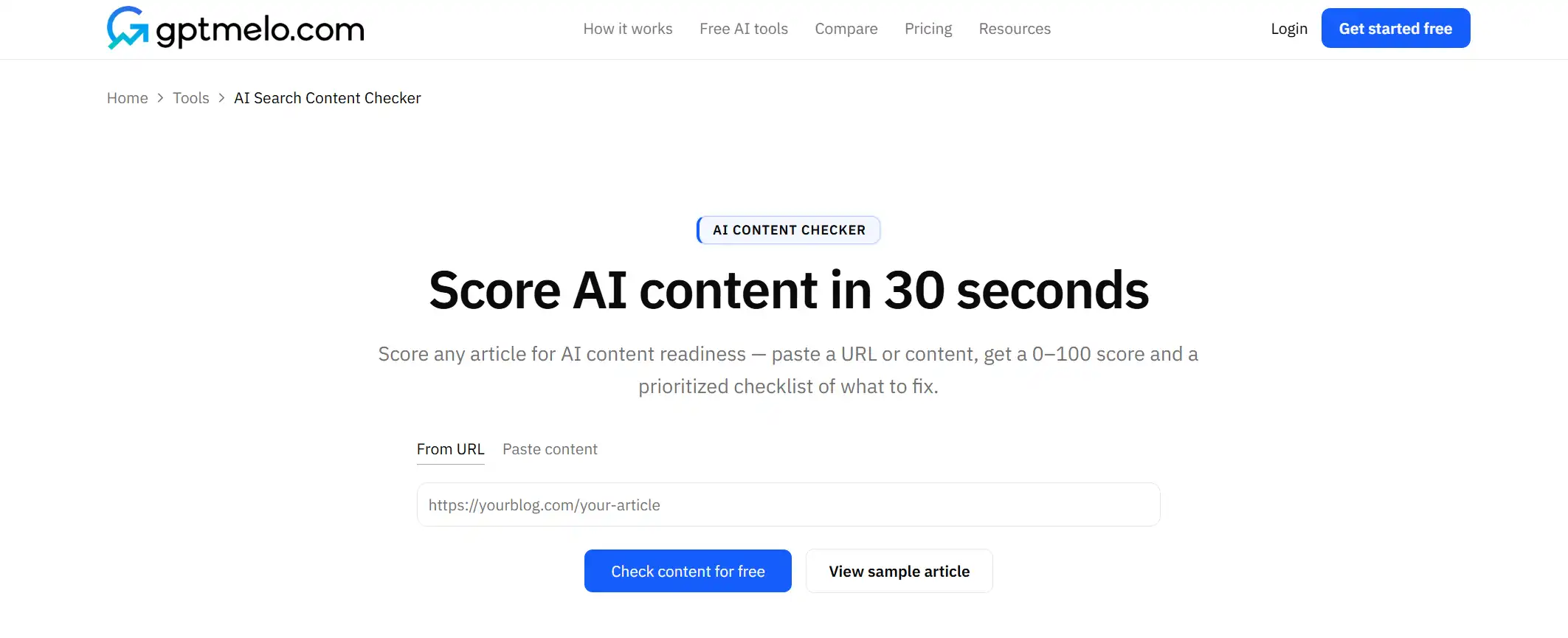
2. Check. Click Check content for free.
3. Read the result. You get a score plus pass/warn/fail rows (topic clarity, brand fit, readability, structure, quotable blocks). The screenshot is a sample — yours follows the URL you pasted. Glance at structure (opening plus lists). The score is not a ranking guarantee.
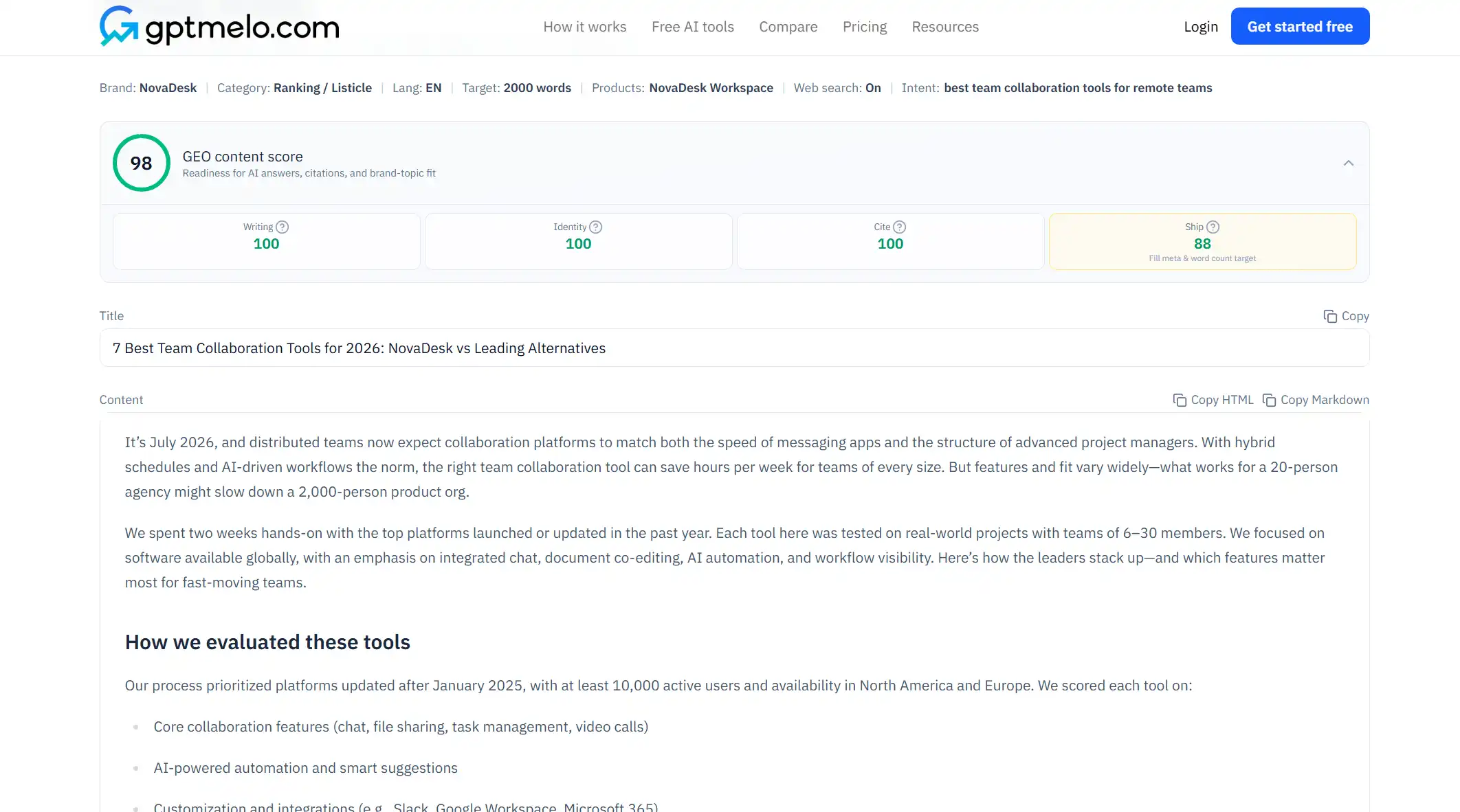
4. Fix the live page, then check again. Edit the HTML people and models actually fetch. Do not treat this window as the page.
For a printable pass list, use the GEO checklist.
FAQ
What is AI content optimization?
Formatting pages so AI search engines can extract clear answers, lists, and attributed facts to cite in generated responses.
How is AI content optimization different from SEO?
SEO targets rankings and clicks; AI optimization targets structure and trust signals that help pages get cited inside generated answers.
Does keyword density still matter?
Less than clear structure. Answer the query early, add scannable blocks, and attribute stats—models skip walls of repeated phrases.
Related reading



Last updated