Optimize Content for AI Search Engines: Answer in Paragraph One
Key takeaways
- Treat AI search as extractable answers on crawlable URLs.
- Workflow: answer early → structure → trust → schema → free check.
- Do not invent a separate keyword universe from classic SEO.
How do you optimize content for AI search engines? Treat them like systems that lift answers from crawlable pages: lead with the claim, support it with a list or table, attribute facts, keep robots and sitemaps honest, then score the URL before you scale. You do not need a separate keyword universe from classic SEO—you need extractable blocks. Use the AI search content optimization checklist as the tick list; this page is the end-to-end workflow.
| When | I’d prioritize | Skip if |
|---|---|---|
| New flagship guide | Answer early + list in first screenfuls | You only change the meta title |
| Comparison / pricing | Complete tables + dated numbers | Cells empty or “contact sales” |
| Template at scale | One URL through the full workflow | Fifty pages only partially fixed |
| After CMS theme change | Re-score structure + schema | You assume design polish is neutral |
| Citation questions next | Prompt-test after structure passes | Page still fails the free check |
Shared patterns across AI search surfaces
Google AI features in Search and standalone assistants differ in ranking, but they share extraction habits:
- Direct answers early
- Lists for how-to queries
- Tables for comparisons
- Sources when numbers appear
- HTML FAQ that matches schema
Optimize for those shared patterns. Model-specific tricks age poorly.
Workflow step 1: Answer the query early
Sentence one states what the reader came for. If the first 100 words cannot stand alone, rewrite before you touch keywords. The craft detail lives in AI content optimization.
Workflow step 2: Structure claim → block → source
Under each major H2: one claim, then bullets or a table, then attribution when you state a fact. Match format to query type (definition paragraph, steps, list, table).
Workflow step 3: Add trust where the topic needs it
YMYL and buyer advice need bylines, real profiles when possible, and sourced claims. Anonymous tips with invented percentages train assistants to invent with you.
Workflow step 4: Align schema with visible HTML
FAQ and Article markup must match the body on factual claims. Validate after CMS changes. Drift is a silent failure mode.
Workflow step 5: Confirm crawl discovery
Sitemaps, robots, and internal links still matter. An extractable page that crawlers never fetch will not appear in AI answers. Fix discovery before you blame content quality.
Workflow step 6: Score, fix the biggest gaps first, re-run
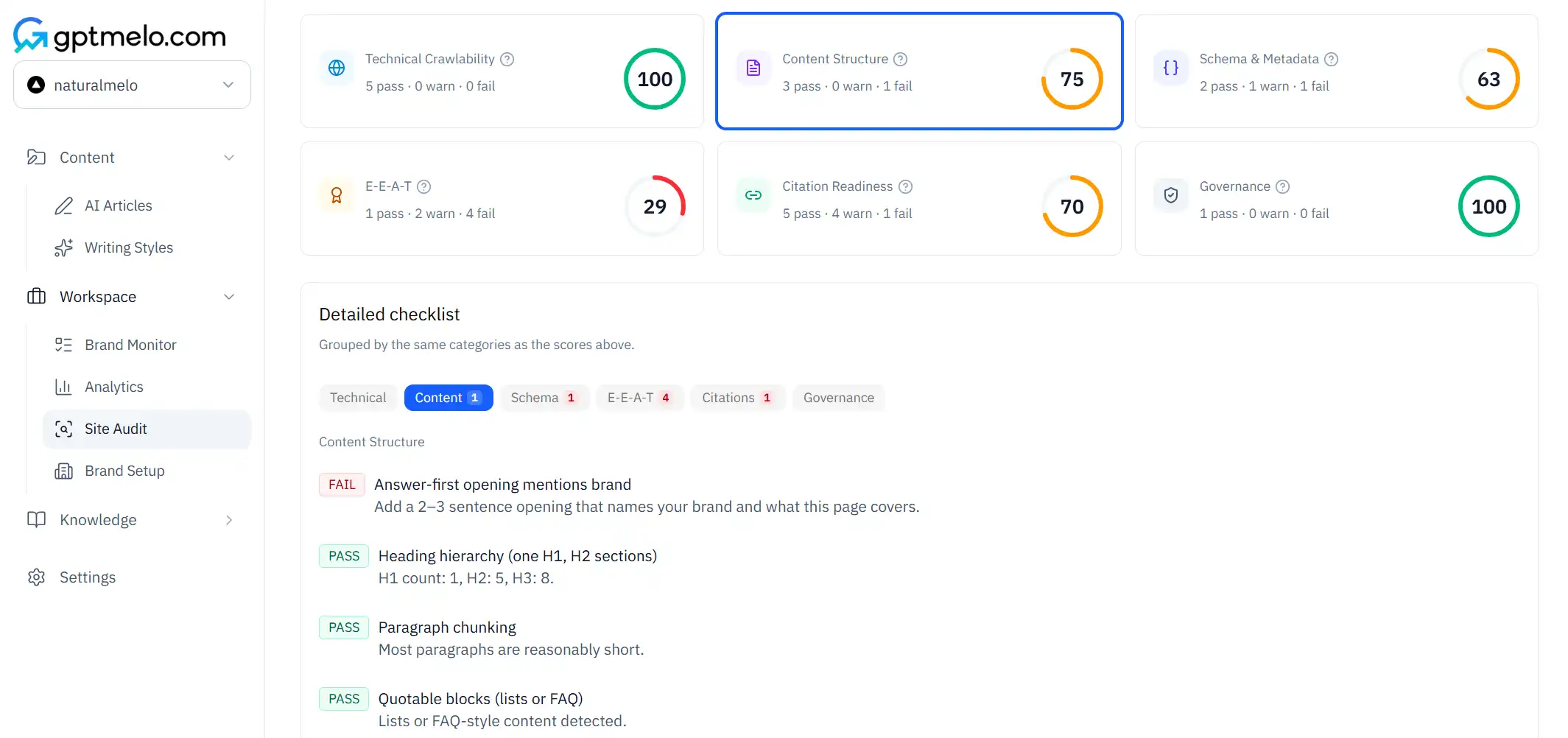
Paste into gptmelo’s GEO Content Checker. Order: intro → lists → tables → then secondary issues. Document the passing template in your CMS.
For the product write, score, and publish loop, see how GEO article writing works. Team checklists: GEO checklist. Classic vs AI workflow split: AI SEO vs SEO.
How to optimize content for AI search
People also search “how to optimize content for AI search” without “engines.” The steps are the same: early answer, scannable blocks, sources, crawl, free check. Do not split that into a second thin page—use this workflow and the checklist.
When stakeholders ask for a one-line process, use this sequence out loud: answer early, structure the block, attribute facts, confirm crawl, score, then scale the template. Anything that skips scoring before you scale is busywork.
Re-run the free check after theme releases even when “only CSS changed.” Heading and FAQ markup regressions love to hide inside design tickets. Keep a named owner for the weekly checker failure list so unfixed structure fails do not sit in a shared inbox nobody opens.
If two teams argue about AI SEO vs classic SEO, point them at shared extractable blocks first, then return to this workflow for the publish path. Do not open a third strategy doc until one priority URL passes.
Document the passing template in your CMS with required fields: intro answer, list or table, source line, FAQ HTML. New writers should inherit the shape, not invent a parallel outline every sprint.
Scale one template before you multiply URLs
The workflow fails most often when teams run steps 1–6 on fifty URLs at once. Half the pages get a clearer intro; the other half keep empty table cells and drifted FAQ markup. You cannot defend “we optimized for AI search engines” with a mixed bag.
I’d start with one flagship URL of the type that drives revenue or support tickets. Run the full sequence until the structure check passes on the live page. Write the required CMS fields into the template brief. Only then clone the shape to the next three URLs in the same family.
Skip if stakeholders demand coverage of every locale in the same sprint. Breadth without a passing template multiplies the same miss. When a theme release lands mid-batch, pause cloning and re-score the reference URL that already passes first—design tickets hide heading and accordion regressions more often than writers expect.
Keep classic SEO work in parallel: intent match and internal links still decide whether the extractable page gets discovered. This workflow makes answers liftable; it does not replace a site nobody can crawl. Share that reference URL and the checker failure list with whoever asks for status. That packet beats a list of fifty “in progress” titles with no pass date.
What not to do
- Invent a parallel keyword map only for “AI”
- Stuff every H2 while the intro stays vague
- Ship AI drafts without a fact-check
- Buy monitors before one template passes structure
- Promise Overview or ChatGPT citations on a timeline you cannot control
Common mistakes
- Running the workflow on fifty URLs before one passes.
- Updating schema without updating visible pricing copy.
- Ignoring robots while polishing prose.
- Measuring success only by plugin greens.
- Cloning competitor listicles with empty cells.
Free check: answer in paragraph one
Open the GEO Content Checker. Paste that search’s live page — the URL that should answer the query, not a staging screenshot. No account required.
1. Fill the form. Keep From URL selected and paste that live page. Switch to Paste content only if fetch is blocked.
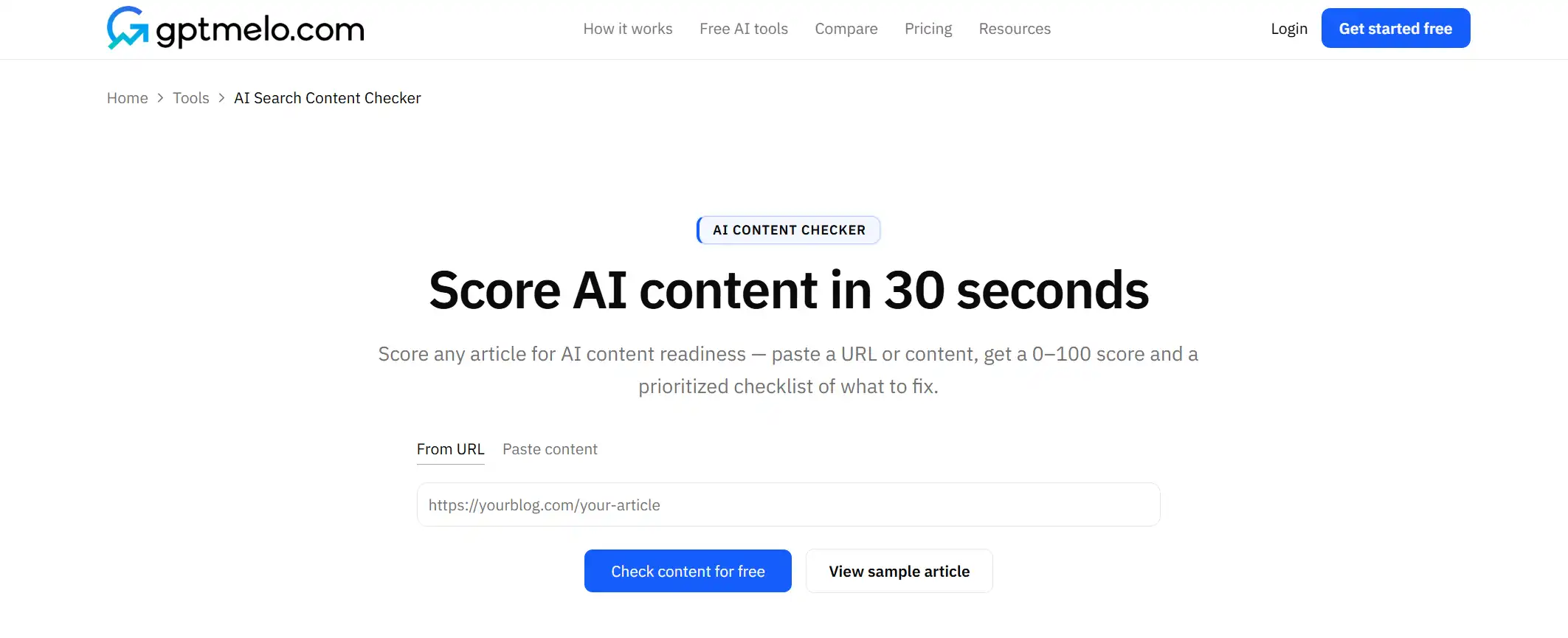
2. Check. Click Check content for free.
3. Read the result. You get a score plus pass/warn/fail rows (topic clarity, brand fit, readability, structure, quotable blocks). The screenshot is a sample — yours follows the URL you pasted. Glance at topic clarity — does paragraph one answer that search? The score is not a ranking guarantee.
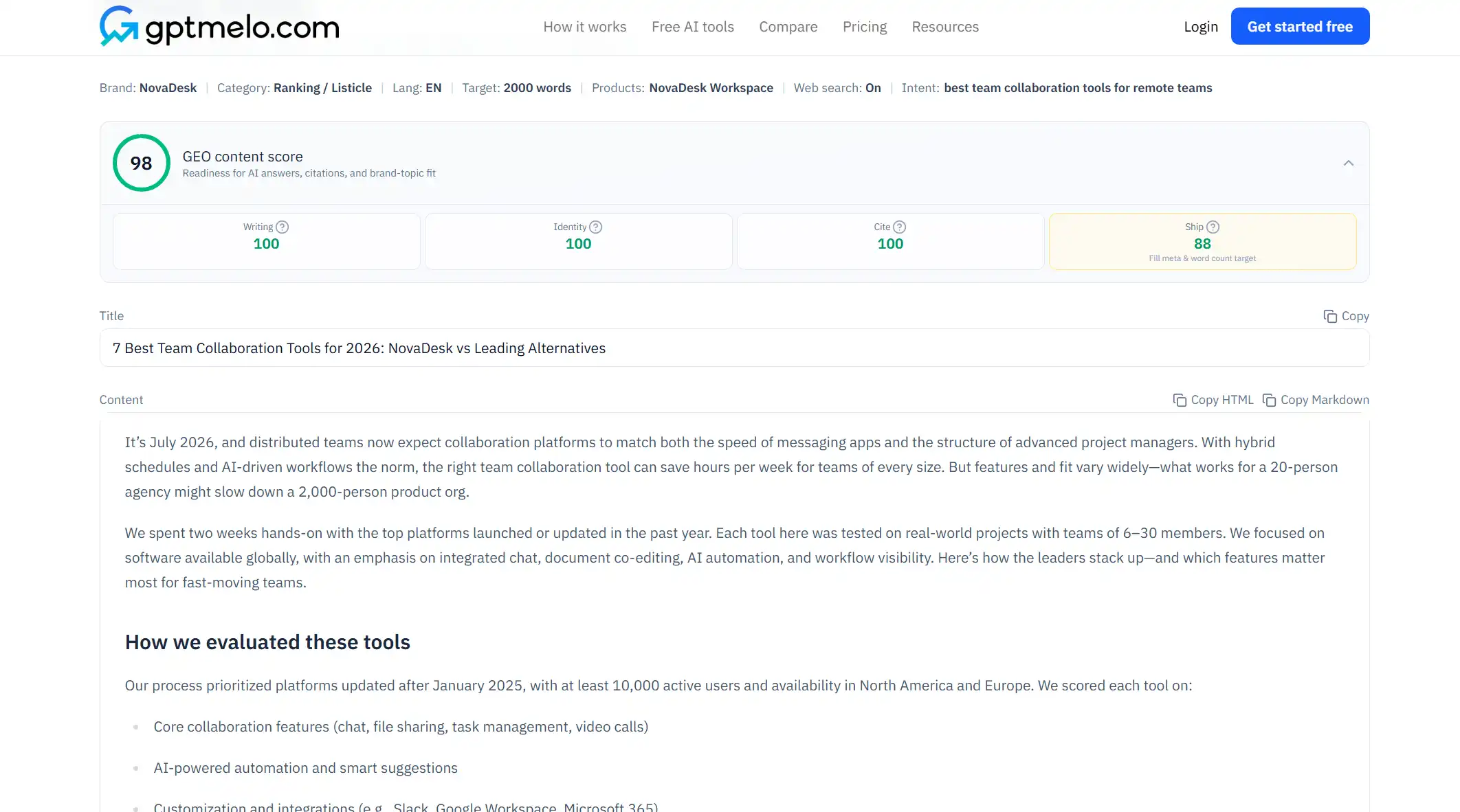
4. Fix the live page, then check again. Edit the HTML people and models actually fetch. Do not treat this window as the page.
FAQ
How do I optimize content for AI search engines?
Answer the query early, add scannable blocks, attribute facts, keep pages crawlable, and validate structure before publish.
Which AI search engines should I optimize for?
Prioritize patterns shared by Google AI features and major assistants—quotable blocks travel better than model-specific tricks.
How is this different from classic SEO?
You still need crawl and intent match; the extra focus is structure built for citations and trust signals inside generated answers.