Does AI Content Optimization Improve Search Visibility?
Key takeaways
- Structure fixes improve extractability; they are not a guaranteed rank boost.
- Track operational signals you control before unverified AI referral metrics.
- Pair optimization with crawl and trust checks.
Does AI content optimization improve search visibility? It improves extractability—how easily search and AI systems can lift a clear answer from your page. That often helps classic SEO too when intros and tables get clearer. It is not a guaranteed jump in rankings or a fixed “AI traffic” percentage. This page separates what moves from what you should not invent. For the how-to system, use AI content optimization.
What “visibility” means here
People mix three outcomes:
- Classic rankings — blue links in Google results
- Extracted answers — snippets, Overviews, assistant citations
- Brand mentions — named in an answer without a click
AI content optimization targets (2) directly and supports (1) when structure and intent improve. (3) needs monitoring after pages are already quotable—see AI citation for that craft.
What usually improves after a real pass
When teams fix intros, lists, sources, and FAQ HTML, they commonly see:
- Priority templates pass a structure or citation readiness check
- Fewer empty table cells on comparison pages
- Schema that matches visible answers
- Cleaner chunks for humans and models
Those are operational wins you can verify in a week. Ranking and citation share still depend on competition, links, crawl, and whether Google or an assistant shows an answer box at all.
What does not automatically improve
Do not promise:
- A fixed percentage lift in organic sessions
- Instant Overview or ChatGPT citations
- That an “AI score” green light equals rankings
Thin rewrites that stuff synonyms while removing sources can hurt both SEO and citations. Labeling a wall of prose “AI-optimized” changes nothing extractors can use.
How to measure without fake lift slides
Track signals you control:
| Signal | Healthy | Weak |
|---|---|---|
| Structure check on priority URL | Passes after fixes | Same fails every week |
| FAQ schema vs HTML | Matches on facts | Drift after CMS updates |
| Table completeness | Every cell filled | Em dashes and “contact us” |
| Manual prompt notes | Named URL when cited | Invented facts, no URL |
Optional downstream metrics (branded search, referral patterns from assistants) vary by analytics setup—directional only. The AI SEO vs SEO resource clarifies workflow splits; the get cited by AI resource covers governance.
A four-week proof loop
- Week 1 — Pick one revenue URL. Score it. Write down top fails.
- Week 2 — Fix intro + one list or table. Re-score.
- Week 3 — Align FAQ HTML/schema if needed. Re-score.
- Week 4 — Ask the same three buyer prompts; note citation and invented facts.
If pass rates move and prompt notes improve, optimization worked for visibility you can defend. If rankings also rise, treat that as a bonus—not the only success criterion.
Share the loop in writing with whoever asks for “AI traffic proof.” Replace percentage folklore with: URL, date scored, fails fixed, prompt notes. That packet survives finance review better than a chart with no method.
When leadership wants a bigger sample, clone the loop across three templates—not thirty URLs at once. Breadth without a passing template only multiplies the same structural miss. Keep classic SEO work (links, intent, technical crawl) in parallel; structure optimization is a layer, not a substitute for a site that cannot be discovered.
If prompt notes still show invented facts after structure passes, the page is missing attributed numbers—not “more AI optimization.” Add sources or delete the claim. Visibility without accuracy is a brand risk.
Pair optimization with crawl and trust
Extractable copy on a blocked URL still fails. Pair structure work with:
- Robots and sitemap health when discovery is suspect
- Author and source signals on trust-sensitive topics
- Stable URLs after you earn citations
Visibility is a stack: crawl → structure → trust → optional monitoring.
When rankings move—and when they do not
Structure work can lift rankings when the page was hard to skim: vague intros, buried steps, incomplete tables. Searchers and systems both get a clearer answer. That is the overlap with classic SEO.
Rankings usually stay flat when the miss is elsewhere—thin topical coverage, weak links, or a query where someone else already owns intent. In that case, extractability still improves: assistants can quote you when an answer box appears, even if the blue-link position barely budges. Treat those as different scoreboards. Do not fold them into one “visibility %” for a slide deck.
I’d start with one revenue URL and two notes: structure pass rate, and whether the same three buyer prompts name your URL. If pass rates climb and prompt notes still invent facts, add attributed numbers—do not rewrite synonyms again. If prompts cite you but rankings lag, keep link and intent work in parallel instead of calling the optimization pass a failure.
Share that split with whoever asks for proof. Operational signals first; ranking lift as a bonus when competition allows it. Skip if leadership only wants a chart with no URL or date on the page.
Run the free check that matches the claim
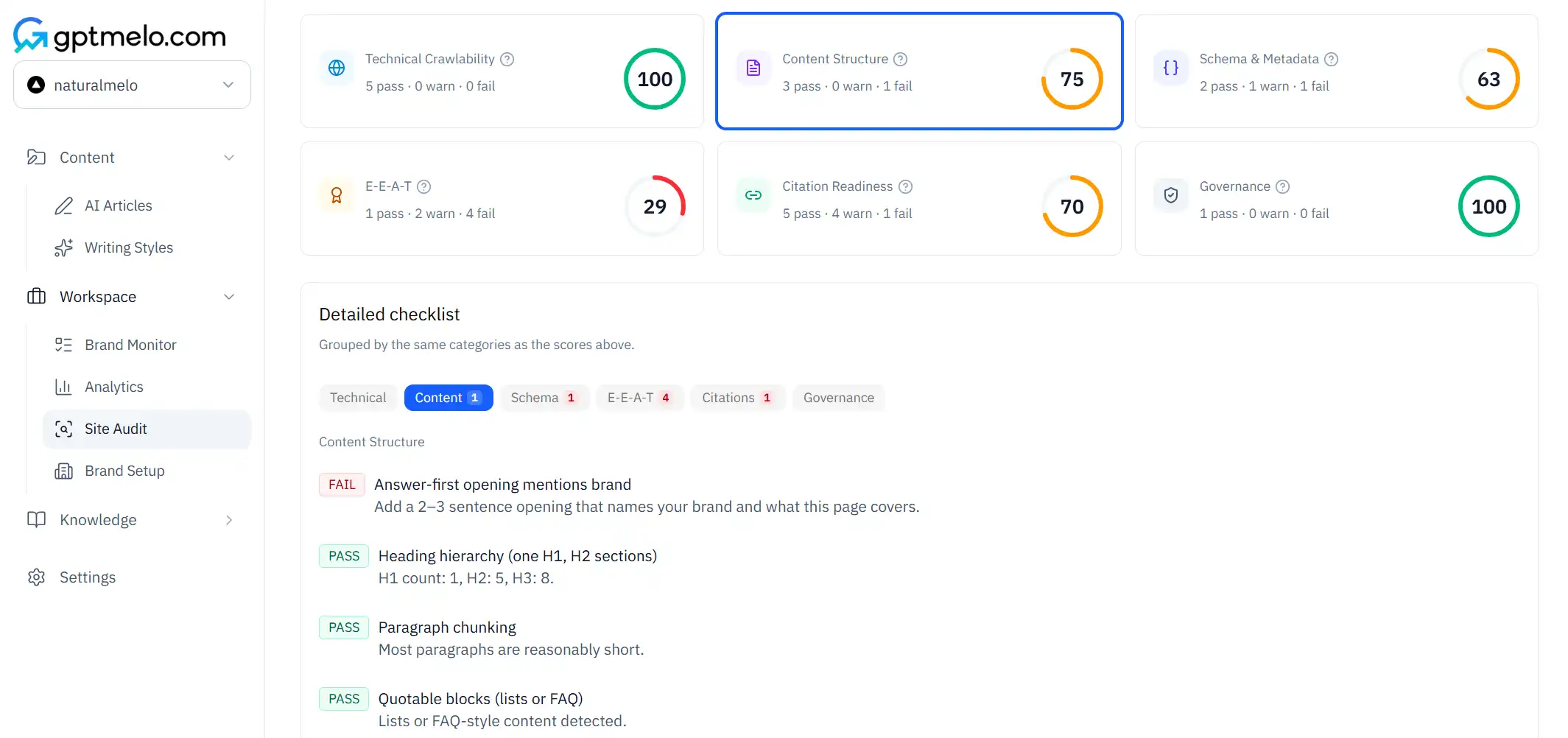
Paste the URL into gptmelo’s GEO Content Checker. Fix the biggest gaps first. Re-run after edits. That is the evidence trail for “we optimized”—not a slide with an invented +40%.
Common mistakes
- Reporting AI traffic lift with no baseline or method.
- Shipping keyword-stuffed “AI rewrites” that remove sources.
- Measuring only plugin greens while tables stay empty.
- Buying citation monitors before one template passes readiness.
- Declaring victory because one Overview appeared once.
Free check: a live URL, not a doc
Open the GEO Content Checker. Paste published HTML — the live URL, not an internal doc. No account required.
1. Fill the form. Keep From URL selected and paste that live page. Switch to Paste content only if fetch is blocked.
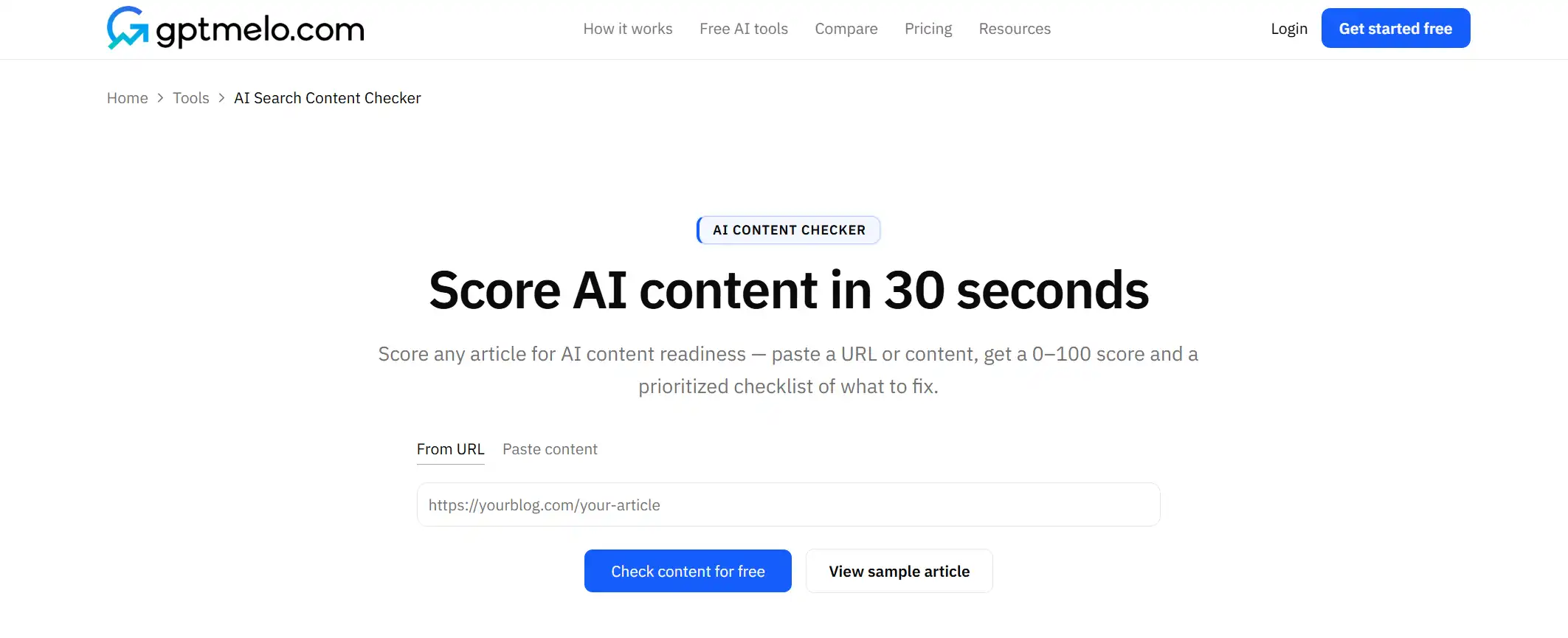
2. Check. Click Check content for free.
3. Read the result. You get a score plus pass/warn/fail rows (topic clarity, brand fit, readability, structure, quotable blocks). The screenshot is a sample — yours follows the URL you pasted. Glance at structure on that live HTML. The score is not a ranking guarantee.
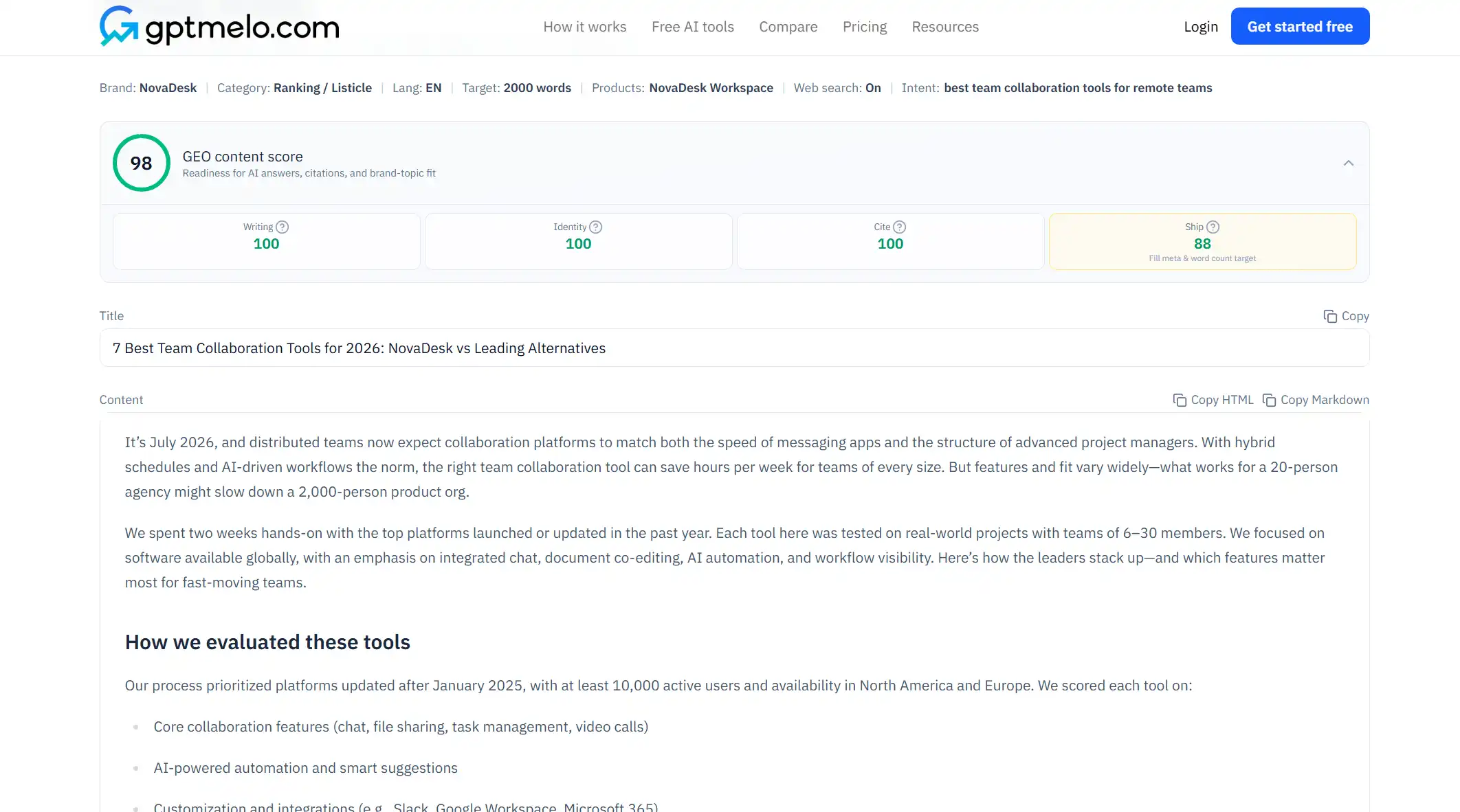
4. Fix the live page, then check again. Edit the HTML people and models actually fetch. Do not treat this window as the page.
FAQ
Does AI content optimization improve search visibility?
It improves how easily systems can quote your pages; classic rankings still depend on links, intent match, and competition.
How do I measure AI content optimization results?
Track template pass rates, schema validity, and citation readiness on priority URLs before chasing unverified traffic lifts.
Can AI optimization hurt SEO?
Thin rewrites or keyword stuffing labeled as AI-ready can hurt. Clear answers and complete tables usually help both.