College AI Detector: What Scores Mean for Student Writing

Key takeaways
- Detector scores are hints—not proof of cheating or authorship.
- Clear structure and cited sources beat gaming detectors.
- Use free writing-pattern checks as editing hints, then revise by hand.
What is a college AI detector? It is software schools use to flag writing that looks like common LLM drafts—uniform transitions, generic claims, and repetitive sentence shapes. A high score is a reason to review process and sources, not automatic proof of cheating. For the general writing-pattern check (not campus policy), see the AI detector guide.
What campus detectors usually score
Most academic detectors estimate how closely a passage matches statistical patterns from large language models:
- Predictable transitions and stock academic fillers
- Low variety in sentence openings
- Claims without named sources, page numbers, or dates
- Paragraphs that sound fluent but never land on a specific example
They do not reliably prove:
- That you never opened a chat tool
- That every sentence is original in a copyright sense
- That non-native or highly formal prose is “AI”
- That the facts in the paper are true
False positives happen. Formal lab reports, translated drafts, and heavy style guides can look “machine-like” to a classifier. Treat the percentage as one signal alongside the syllabus, the assignment prompt, and your revision trail.
Why chasing a green score can hurt the paper
Students (and freelancers) sometimes rewrite only to lower a detector bar. That often makes the work worse:
- Specific quotes get replaced with vague paraphrase
- Methods sections lose numbered steps
- Citations get thinned so the prose “flows”
Instructors care about learning outcomes, attribution, and whether the argument is yours. A smoother paragraph that drops sources fails that test even if a widget turns green. The same trap shows up in marketing copy—see AI humanizer for readability edits that keep facts intact.
When a free writing-pattern check helps students
Useful
- Spot which paragraphs sound generic after a brainstorming chat
- Compare a draft before and after you add quotes, data, and your own examples
- Practice noticing stock transitions before you hand the paper in
- Check a section you wrote quickly at 2 a.m. when everything sounds the same
Poor uses
- Treating one score as a cheating verdict
- Running twenty synonym passes instead of adding sources
- Submitting work you cannot explain in office hours
- Ignoring the course policy on allowed AI tools
Course rules differ. Some allow outlining help; some ban generators entirely. Read the syllabus first. A pattern check does not override policy.
Step 1: Keep a trail you can show
If your school allows limited AI use—or even if it does not—save:
- Assignment prompt and due date
- Outline or notes in your own words
- Draft versions with timestamps when possible
- Sources with links or DOIs you actually opened
When a detector flags you, the conversation goes better with a trail than with “the tool is wrong.” Honesty about process beats a rewrite contest.
Step 2: Fix flagged sections with evidence, not synonym swaps
For each flagged paragraph, ask:
- Does sentence one state a claim I can defend out loud?
- Is there a named source, quote, or data point?
- Did I add an example from the reading, lab, or case—not a generic “companies today”?
Rewrite toward specificity. That usually improves both grades and detector noise without promising any score.
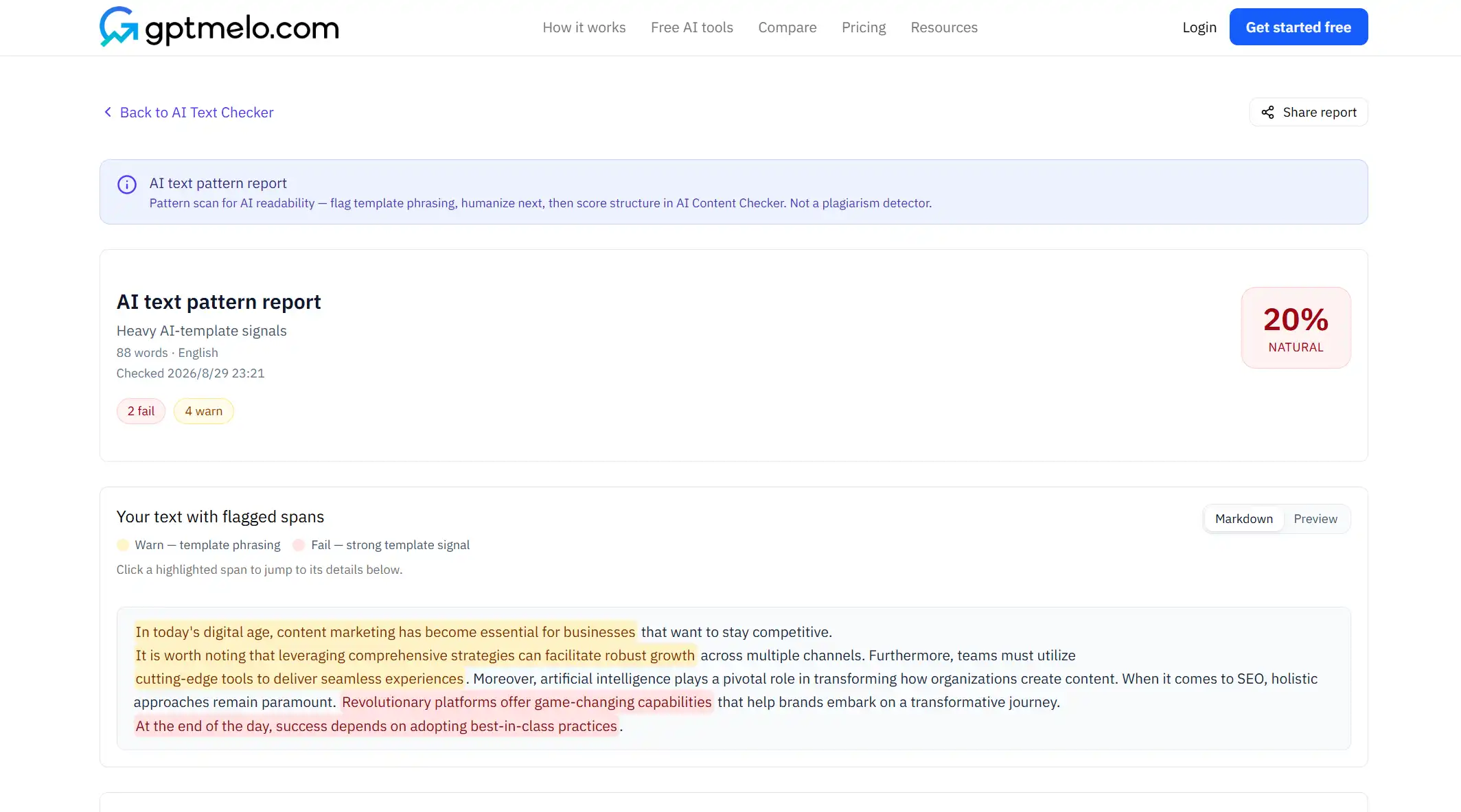
Paste a draft section into gptmelo’s AI Text Checker when you want a second look at repetitive patterns—then edit by hand. Do not treat the percentage as the reason to submit or hold the paper.
Step 3: Separate readability from evasion
Clarity edits are fair: shorter sentences, active verbs, concrete nouns. Evasion edits are a different job—rewriting only to fool a classifier. Schools and platforms increasingly treat that as policy risk. If the draft is stiff, improve rhythm after facts are solid; do not strip attribution to sound “more human.”
Team-style edit habits for AI-assisted drafts live in the edit AI content resource—students can steal the accuracy and sourcing checklist even when the audience is a professor, not a marketing CMS.
How instructors can use detectors without turning them into courts
Detectors help as a first filter: which papers need a conversation. They fail as sole evidence. Pair a flag with:
- An oral check on methods or sources
- Draft history when the LMS stores versions
- Comparison to earlier writing from the same student when available
Publish a clear AI policy on the syllabus: what is allowed, what must be disclosed, and how disputes work. Ambiguous rules push everyone into endless checker games.
College detectors vs marketing “AI detectors”
Same family of tools, different stakes:
| Context | Good outcome | Bad outcome |
|---|---|---|
| Campus paper | Process + sources reviewed | Score used as sole cheating proof |
| Blog or product page | Flag sections for human edit | Synonym swaps that hurt clarity |
| GEO / citations | Structure and attribution stay | Lists and facts removed to “pass” |
If you write for the open web as well as class, keep structure habits from the general detector guide linked above—and never sell rewrites whose only purpose is to fool a classifier.
Common mistakes
- Panicking at a percentage without reading which paragraphs flagged.
- Deleting citations to lower a score.
- Submitting work you cannot summarize without the chat log open.
- Assuming ESL or formal style equals misconduct.
- Using a detector as the only classroom policy.
Free check: a section, not a whole paper
Open gptmelo’s AI Text Checker. Paste 50–1,000 words from one section—not the full paper. No account required.
1. Fill the form. Paste that section in the text field (cap is 1,000 words).
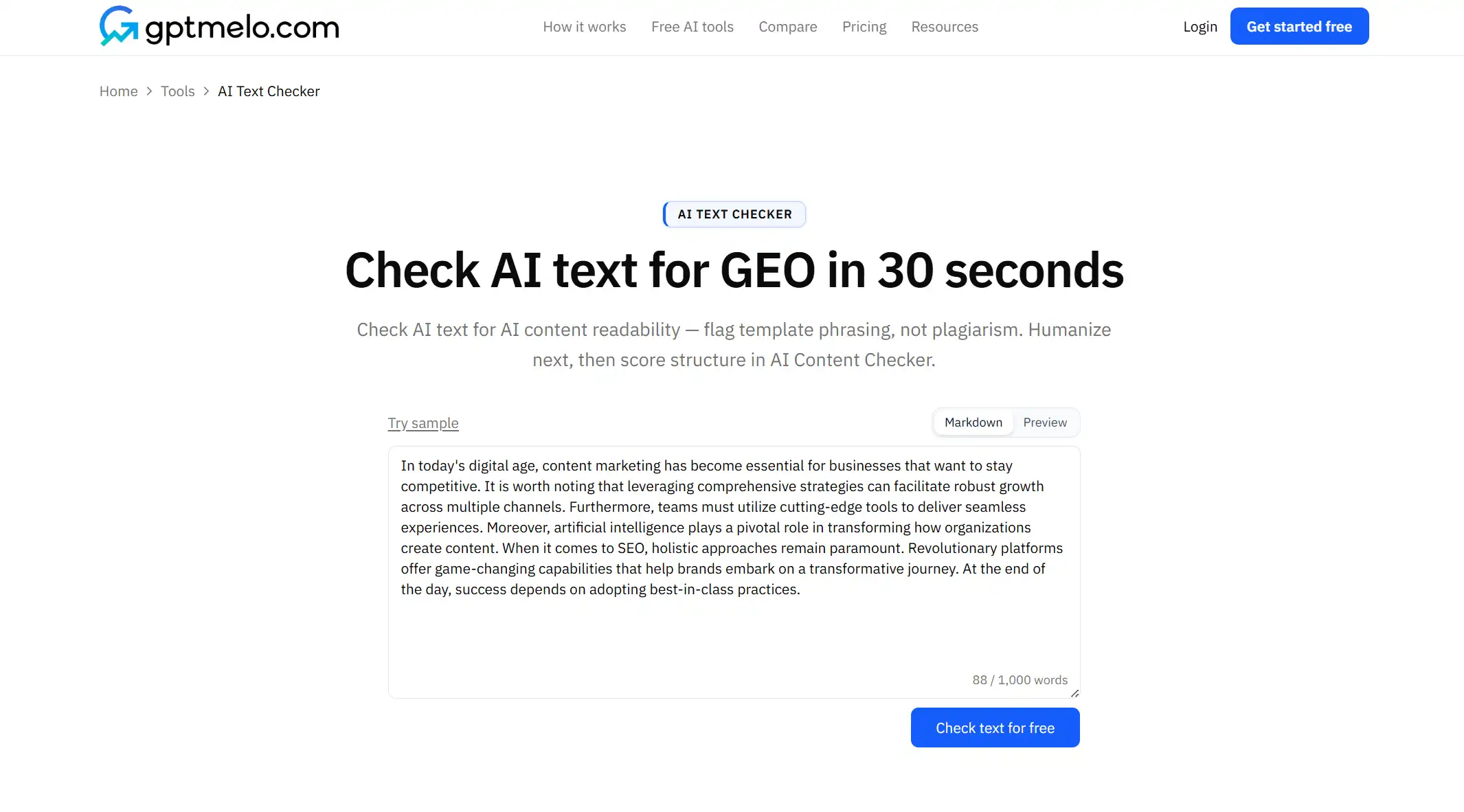
2. Check. Click Check text for free.
3. Read the result. You get a pattern score and flagged spans—not a plagiarism percentage and not a school detector verdict. The screenshot is a sample — yours follows the text you pasted. Glance at the score; it is not the same as a classroom tool.
4. Edit the draft. Add sources and your own examples in the document, then paste the section again. Do not treat this window as the submitted paper.
FAQ
What is a college AI detector?
Software schools use to flag writing patterns associated with AI drafts—it can false-positive on formal or non-native prose.
Are college AI detectors accurate?
Accuracy varies; treat scores as a signal to review process and citations, not as definitive proof.
How should students respond to a detector flag?
Show drafts, sources, and revision history; improve clarity and attribution rather than rewriting only to fool a detector.