AI Detector 2026: Free Checks for Writing Patterns

Key takeaways
- Detectors flag patterns—not proof of quality or originality.
- Use them to spot sections that need a hand-edit.
- Structure and citations matter more than detector scores for GEO.
What is an AI detector? It is a tool that estimates how closely a passage matches common LLM writing patterns—uniform transitions, vague claims, and repeated sentence shapes. It is an editing signal, not proof that a human did or did not write the page.
What AI detectors actually measure
Most detectors score statistical patterns, not intent:
- Predictable transitions (“Furthermore,” “In conclusion,” “It is important to note”)
- Low lexical variety across paragraphs
- Generic claims without names, dates, or links
- Paragraphs that mirror training-data cadence from popular LLM defaults
They do not reliably tell you:
- Whether facts are true
- Whether the page will rank or get cited in ChatGPT
- Whether a skilled human edited an LLM draft
- Whether translated or ESL copy is “AI” in a meaningful sense
OpenAI has publicly said there is no reliable way to detect all AI-generated text at scale. Treat any percentage as one editor’s second opinion, not a courtroom exhibit.
Why detector scores are a bad reason to block publish
Teams chase detector scores because the number feels objective. In practice, chasing the score often damages the page:
- Lists get collapsed into fluffy prose
- Specific stats get replaced with vague adjectives
- Intros stop answering the query in sentence one
Google’s guidance on scaled content focuses on helpful, people-first pages—not third-party “AI %” widgets. For GEO, models cite clear structure and attributed facts more than natural-sounding filler.
If your goal is AI visibility, review AI content optimization structure habits before you obsess over detector color codes.
When a free AI detector helps
Good uses
- Spot which sections need a hand-edit after ChatGPT or Jasper-style drafts
- Compare before/after once you add citations and concrete examples
- Train junior writers on repetitive patterns (same opener, same transition chain)
- QA spot checks on support macros or release notes
Poor uses
- Auto-rejecting freelancer submissions from a single score
- Publishing only when the bar turns green
- Accusing writers of fraud without reading the draft
- Replacing fact-checking or legal review on YMYL pages
The edit AI content resource covers the accuracy, sourcing, and voice work detectors cannot replace.
Step 1: Fact-check before you interpret the score
A high “AI” score on text that invents pricing is the least of your problems. Verify numbers, product names, and URLs against a fact sheet or live pages as of [[MONTH_YEAR]] first.
If the draft fails accuracy, fix sources before you tune rhythm. The ChatGPT content generation workflow puts facts ahead of fluency for the same reason.
Step 2: Run the checker on sections, not the whole site
Paste one H2’s prose at a time into gptmelo’s AI Text Checker. Whole-page dumps mix human disclaimers, templated tables, and LLM body copy—scores become meaningless.
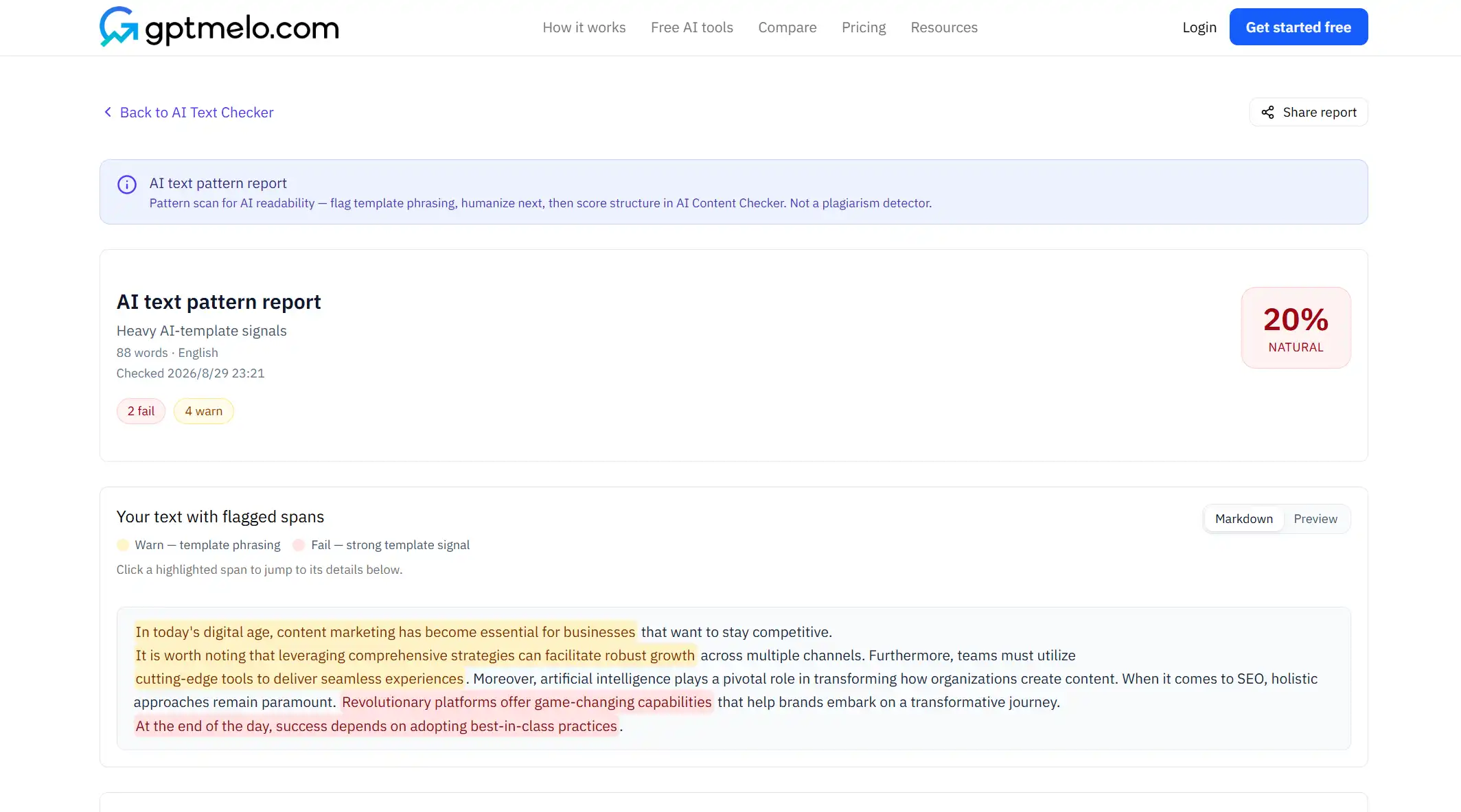
Note which sections flag:
- Intro and conclusion —usually worth hand-editing even when the middle is fine
- Repeated list intros —often one template copied across H2s
- Boilerplate policy blocks —may flag high even when accurate
Write down the flagged paragraph, not just the percentage. You need a rewrite target.
Step 3: Edit for specifics, not camouflage
On flagged sections, try this order:
- Add a named source —link the stat, quote the doc, name the product tier
- Swap abstract nouns for concrete ones —“the platform” →your product name + one limitation
- Break template rhythm —vary how H2s open; not every section needs “When it comes to—
- Read aloud —if you stumble, a detector probably dislikes the cadence too
Do not:
- Spin the same paragraph through five rewriters to game the score
- Delete bullets because lists “look templated”
- Remove dates and attributions to sound more casual
That path conflicts with the AI humanizer guide: humanize for readers, not detector bars.
Step 4: Re-check structure before publish
Prose that scores well on detectors can still fail citation extraction. After edits, confirm:
- Sentence one under the title still answers the query
- Tables and bullets survived the rewrite
- FAQ answers match visible HTML on the page
Use the same structure habits from the AI content optimization guide—detector score and structure for citations are related problems, but only structure has a clear fix list.
Are AI detectors reliable? What the research says
Independent tests find wide disagreement between vendors on the same paragraph. Short texts, edited LLM drafts, and technical docs produce false positives and false negatives.
Practical rule for content teams:
- Never auto-publish or auto-reject on score alone
- Do use scores to prioritize which paragraph gets ten minutes of human attention
- Do document which tool you used if a client asks—compare trends on the same tool, not absolute truth
For academic integrity use cases, institutions combine detectors with process evidence (draft history, interviews). Marketing teams rarely need that stack—a hand-edit plus structure check is enough.
Detector vs humanizer: different jobs
| Tool | Question it approximates | Risk if misused |
|---|---|---|
| AI Text Checker | “Does this read like default LLM cadence?” | Treating score as authorship proof |
| AI Text Humanizer | “Can we smooth stiff phrasing?” | Erasing facts or lists while chasing tone |
| GEO Content Checker | “Can models extract answers from this page?” | Ignoring it because the detector score looked fine |
Run detector →hand-edit →optional humanizer on stiff lines →structure check. Skipping the last step is how pages sound natural and still fail to cite.
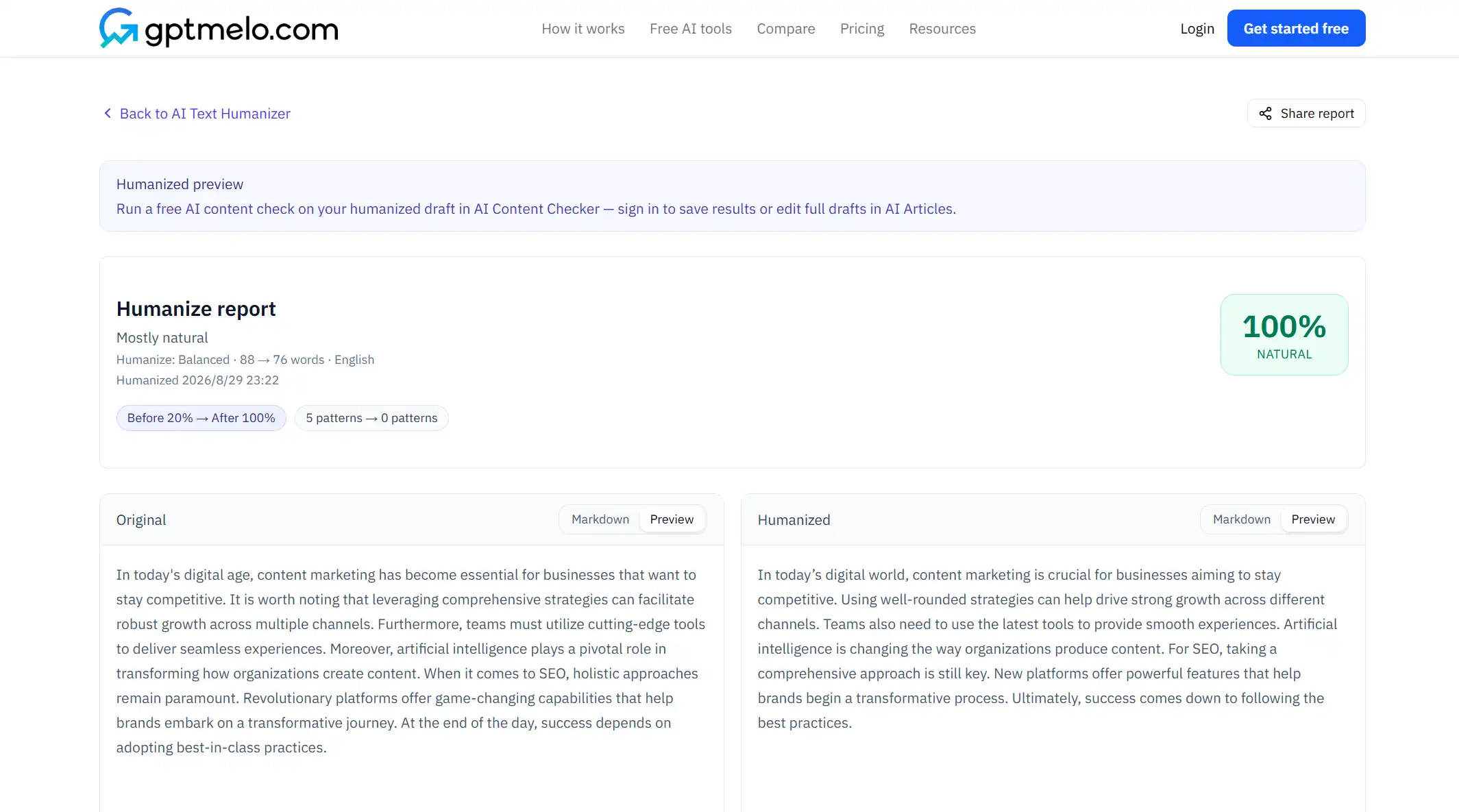
Common detector flags and fixes
| Pattern | Why checkers notice | Fix |
|---|---|---|
| Identical H2 openers | Template reuse across sections | Rewrite sentence one per H2 to answer that heading |
| Unsourced superlatives | Generic training phrasing | Delete or tie to a cited benchmark |
| Transition chains | “Moreover / Furthermore / In addition” stacks | Lead with the claim; cut half the connectors |
| Empty intensifiers | “Robust,” “seamless,” “cutting-edge” | Name mechanism or drop the adjective |
| Wall-of-text specs | Uniform sentence length | Split into bullets with complete cells |
Who should not rely on detectors
- Legal, medical, and finance pages where counsel owns the words
- Localized copy translated from another language—scores are noisy
- Highly templated docs (API parameters, changelogs) where repetition is correct
- Executive bylines ghostwritten and fact-checked—process matters more than cadence
From draft to publish
- Draft —outline-first; section prompts if you use ChatGPT.
- Fact-check —numbers, names, URLs.
- Section detector check —flag weak paragraphs; note rewrite targets.
- Hand-edit —specifics, sources, rhythm; optional humanizer on stiff lines only.
- Structure check —intro, lists, tables, FAQ alignment.
- Publish —record verify date on pricing or feature claims.
Skipping step 2 or 5 leaves you optimizing the wrong problem.
Common mistakes
- Publishing because the detector said “human” while stats are still invented.
- Rewriting entire articles to chase a score while the intro still buries the answer.
- Running five different detectors and picking the nicest result.
- Using detectors on mixed human+template pages without isolating sections.
- Assuming SEO or GEO success follows a green bar.
- Promising clients you can “guarantee undetectable AI copy”—that is not a credible workflow.
Free check: a pattern score, not a verdict
Open the AI Text Checker. Paste 50–1,000 words from one section. No account required.
1. Fill the form. Paste that section in the text field (cap is 1,000 words).
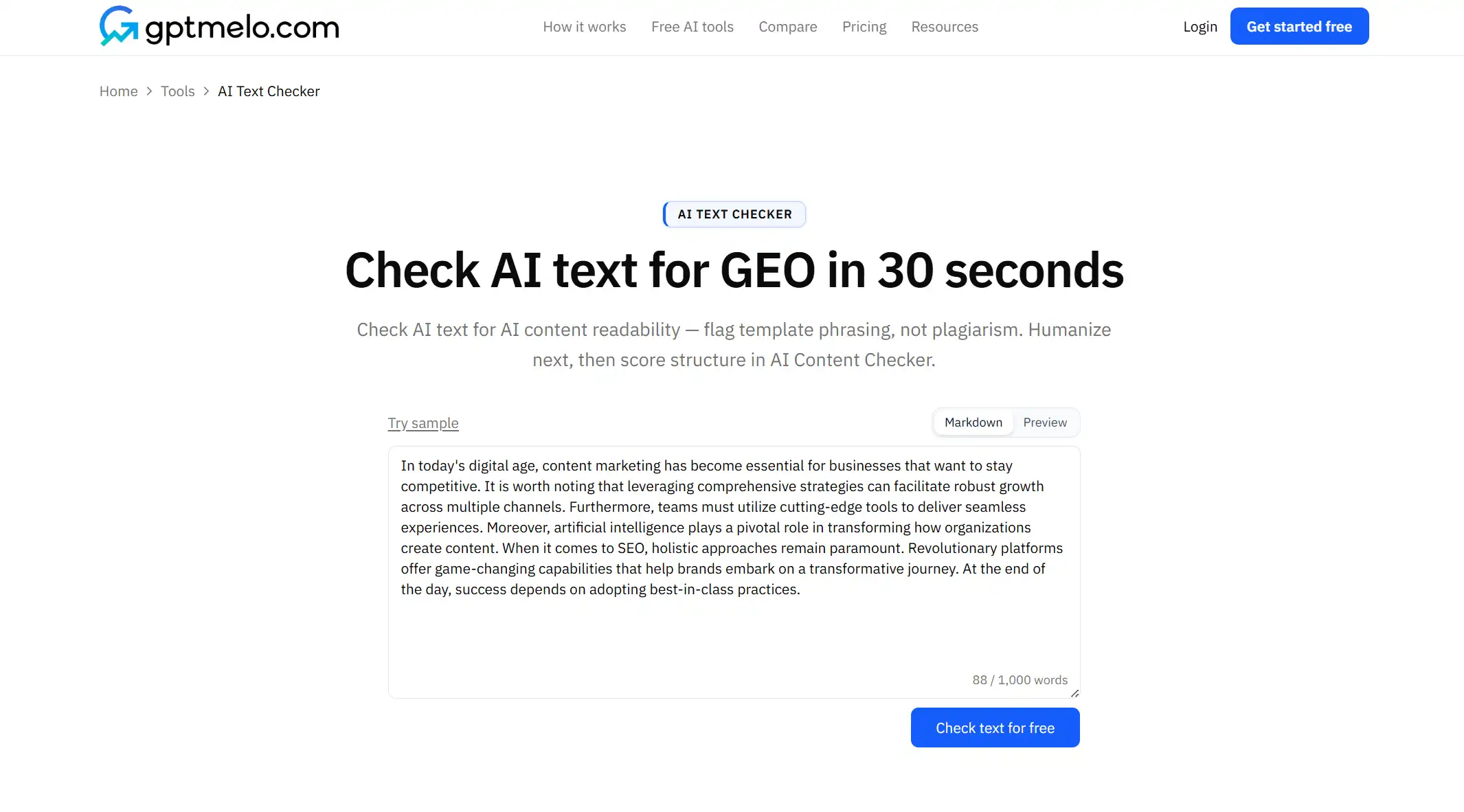
2. Check. Click Check text for free.
3. Read the result. You get a pattern score and flagged spans—not a plagiarism or authorship percentage, and not a reason to block publish. The screenshot is a sample — yours follows the text you pasted. Glance at the score as an editing hint.
4. Edit the draft. Hand-edit what flags, then paste the section again. Do not treat this window as the live page. Smoothing stiff lines later is optional; do not chase undetectable copy.
FAQ
Are AI detectors accurate?
They are inconsistent—treat scores as editing hints, not verdicts on authorship or quality.
Can detectors hurt SEO?
Google does not use third-party detector scores as ranking signals. Low-quality or misleading content is the risk, not a percentage on a checker.
What should I do if text flags as AI?
Add specifics, named sources, and varied sentence rhythm on the flagged section—then fact-check and re-run structure checks before publish.