Content Writing Tips: Name the Reader, Then One Point
Key takeaways
- Content writing tips that work start with a named reader and a point they can finish—not a long adjective list.
- A content writing strategy for one piece is reader, point, format, and proof. Then draft. Then edit facts.
- Draft in GEO Content Writer after those four are named; edit before you publish.
Content writing tips only help if they finish a piece a named reader can use. A list of fifty adjectives will not. Name the reader, name the point, pick a format, then draft. That is a content writing strategy you can run today. Content writing examples below show a weak opening next to a usable one.
| When | I’d prioritize | Skip if |
|---|---|---|
| You still need the meaning of the term | The definition, then come back | You already know what content writing is |
| You mixed an ad with a how-to | Split click vs useful page first | You only needed a button label |
| You have a fluent ChatGPT dump | Name reader and point, then edit | You type “write content” with no reader |
| You need to ship one piece today | The tips below, in order | You wanted a forty-item adjective list |
Name the reader and the point
Write both in one sentence before the body.
Weak: “This guide is for anyone interested in our product.”
Strong: “This page is for a teammate who has to export last month’s report to CSV before Friday.”
If you cannot name the person, you will write for everyone and answer no one. If you cannot name the point, you will open with history. The full definition—reader, point, format, proof—is in what is content writing. Use these tips when you already want a useful page, not a slogan.
If the piece is actually an ad, stop. That is copywriting. That difference is in copywriting vs content writing.
A content writing strategy for one piece
Most content writing strategies fail because they describe a year of titles and never finish the draft in front of you. A content writing strategy for one piece is four lines:
- Reader — one person, in one sentence.
- Point — what they can do or know when they finish.
- Format — help steps, explainer, educational email, or article.
- Proof — a step list, one example, or a source for any number they might act on.
Then draft that piece. Then edit. Then publish. Then pick the next piece.
Do not wait for a long form with audience, funnel, and keywords. Those belong in a longer planning doc if your team needs one. They are not a substitute for the four lines. If the format is an article, how to write it is in article writing. If that article has to rank for one query, use article writing for SEO.
If you draft in ChatGPT, paste the four lines first. Outline-first prompts are in ChatGPT for content generation. “Write content” with no reader produces a fluent dump you will have to rebuild.
Content writing examples
Content writing examples work when you can copy the outline, not the sentences.
Example 1 — help paragraph
Weak: “Exporting reports is an important part of staying organized, and our product makes it easy.”
Strong: “Open Reports, pick last month, choose CSV, and save the file. If the button is gray, you do not have export permission—ask the workspace owner.”
Example 2 — update email
Weak: “We are excited to share some updates from the team this week.”
Strong: “CSV export now includes the owner column. If you already have a saved report, open it once so the new column appears.”
Example 3 — explainer opening
Weak: “Passwords have been around for a long time, and security continues to evolve.”
Strong: “To change a shared account password, rotate it in the password manager first, then tell the two people who use the login—never in the same chat as the new password.”
The strong lines already give the answer. The weak lines make the reader hunt. If your draft starts like the weak line, cut it and put the point first.
These examples are work tasks. They are not homework essays, not ads, and not a list of keywords.
Cut what is not a useful page
Before you add more tips, delete:
- A slogan with no steps
- Company history the reader did not ask for
- Unsourced numbers they might act on
- A ChatGPT dump with no headings
- A hard sell stuffed under a how-to that never finishes the task
What remains should still match the four lines. If it does not, you do not have a tips problem. You have a missing reader or a missing point.
Edit before you publish
Read the draft as the person you named. If you cannot retell the point aloud, they cannot either.
Cut filler adjectives. Cut any section that does not serve the point. Keep numbered steps when the format is a how-to. Keep one example when the format is an explainer.
For a human edit after a model draft, see edit AI content. Do not treat a detector score as the reason to hit publish. Usefulness is what counts.
If the page also has to rank, put the answer in the first paragraph and use searcher words where they fit. How to write that body is in SEO content writing. Do not stuff headings.
Common mistakes
- Collecting tips instead of finishing one piece
- Writing for everyone, so no opening names a real person
- Starting with history instead of the point
- Calling an ad content writing
- Pasting a fluent ChatGPT dump with no reader and no headings
- Planning a year of titles and shipping nothing this week
- Never reading the draft aloud as the person you named
Free check: name the reader, then one point
Open gptmelo’s GEO Content Writer. Draft a named reader plus one point — not a pile of adjectives. No account required.
1. Fill the form. Topic is: this page is for a teammate who must rotate a shared login before Friday; they change it in the password manager first, then tell the two people who use it. Brand name and Brand website are the workspace that owns that login. Open More options only if you need them.
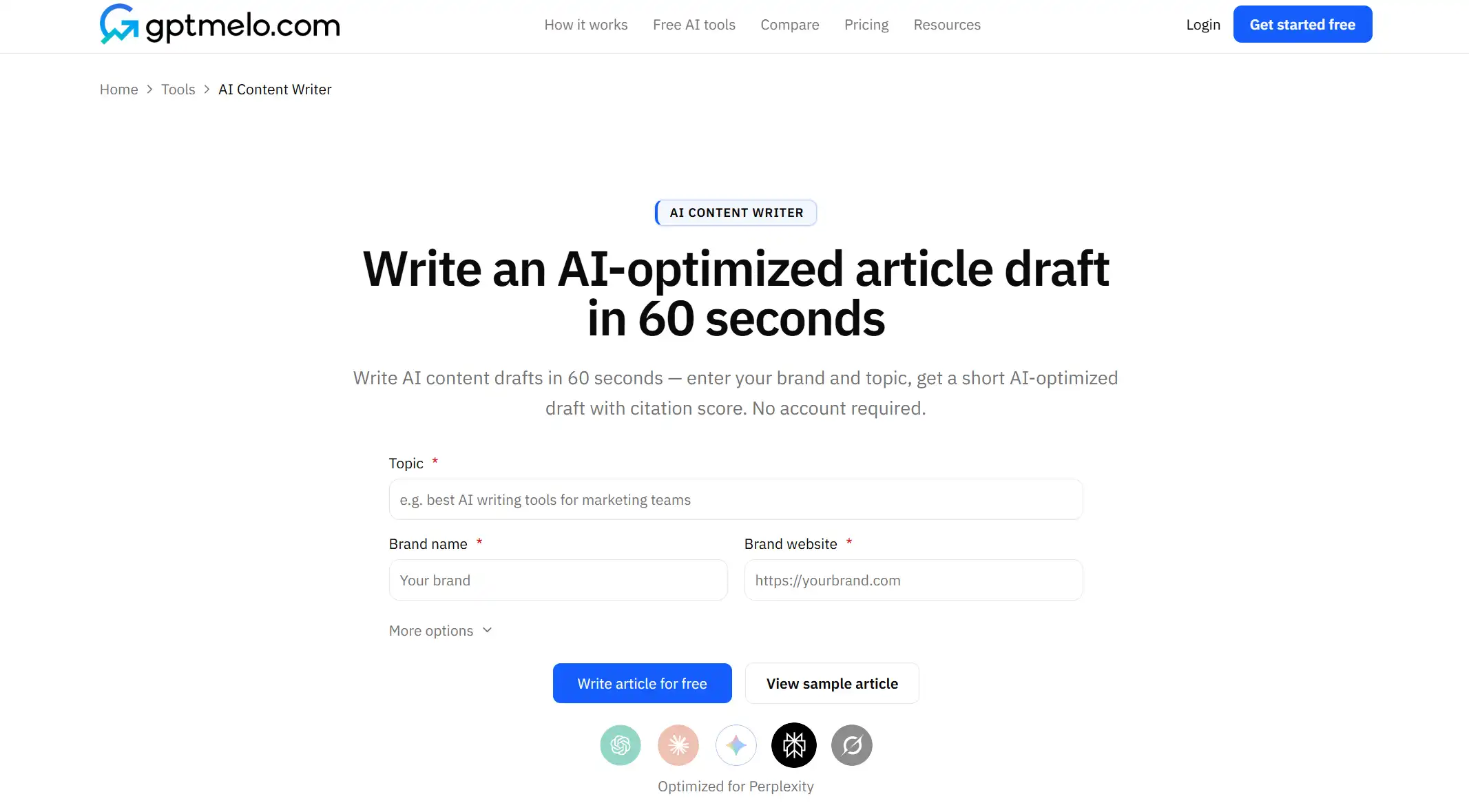
2. Write. Click Write article for free.
3. Read the result. You get a draft next to a GEO content score (Writing, Identity, Cite, Ship). The screenshot is a sample — yours follows Topic. Check paragraph one: does it still name that teammate and that one point? Use Copy HTML or Copy Markdown. The score is not a fact check.
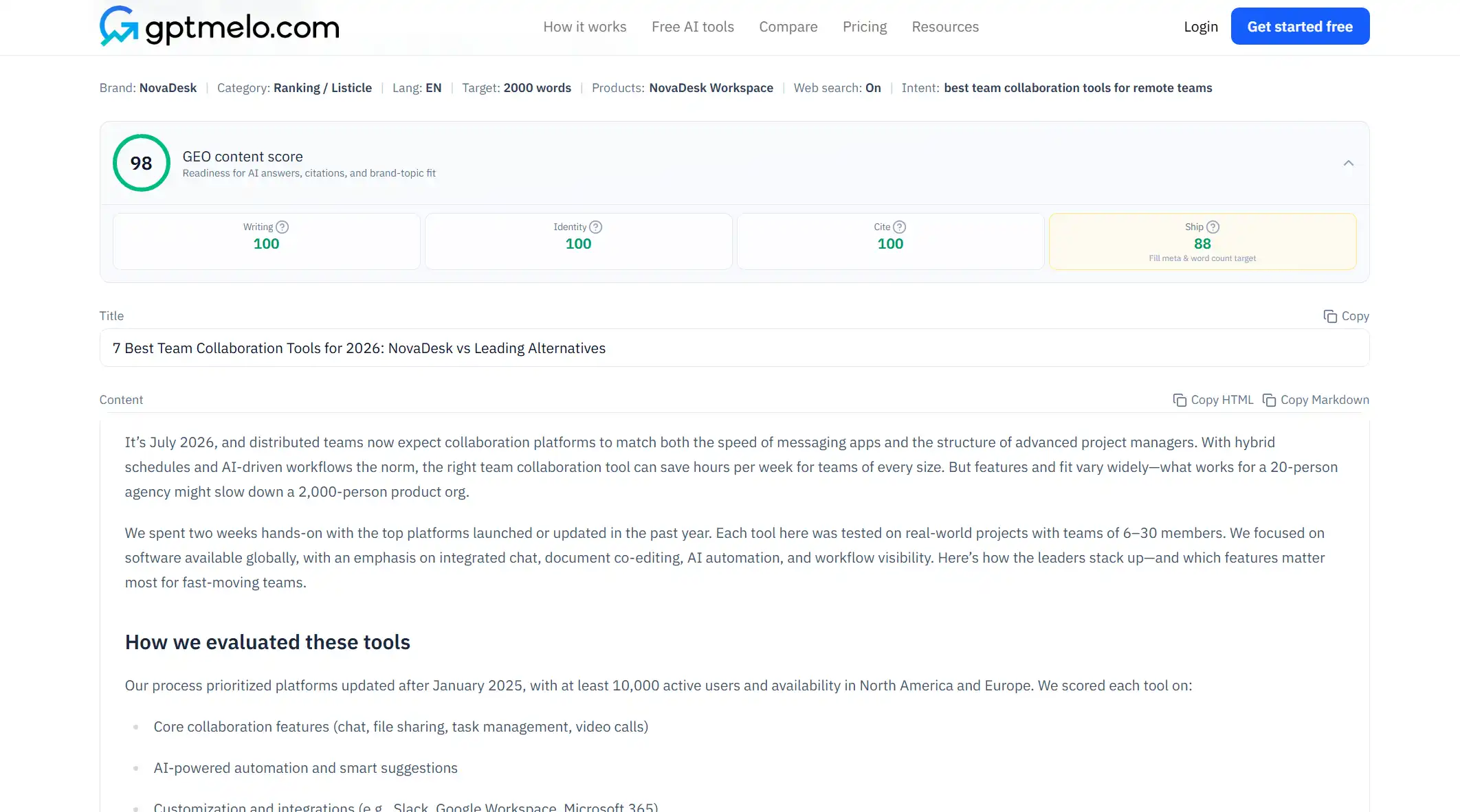
4. Edit, then put it on a URL. Read the draft before anyone else sees it. Do not treat this window as the live page.
The write-check-publish path is in GEO article writing.
FAQ
What are content writing tips that actually help?
Name the reader, state the point in the first paragraph, pick a format they can scan, and cut unsourced numbers. Tips that only say “be clear” or “use keywords” do not finish a piece.
What is a content writing strategy?
For one piece: who it is for, what they should be able to do or know, what format you will use, and what proof you will include. A calendar of titles is not a strategy for the draft in front of you.
What are content writing strategies besides that?
Same idea at a larger scale: finish one useful piece, then repeat. Do not start with a fifty-page plan and no reader. Strategies fail when they describe a year and never ship a page.
What are good content writing examples?
A help paragraph that states the clicks, an update email that names what changed, and a weak intro rewritten so the point lands first. Copy the outline, not the topic.
Are content writing tips the same as copywriting tips?
No. Copywriting tips aim at a click. Content writing tips aim at a reader who can finish a task or understand a topic. If you need that difference, use the copywriting vs content writing comparison.