SEO Content Writing: One Query, One URL

Key takeaways
- SEO content writing is one query, one URL, then an outline that answers that query.
- Put the answer in the first paragraph and use the searcher's words where they fit—do not stuff headings.
- Draft in GEO Content Writer after you have a brief; edit facts before you publish.
What is SEO content writing? It is the work of turning a search query into a crawlable page that answers it—not stuffing a phrase into every heading. SEO content writing starts with intent, then an outline, then copy a person can use. The definition of SEO writing is in what is SEO writing. This page is how you write the draft.
| If this is you | I’d start here | Skip if |
|---|---|---|
| New URL for one search query | Map intent, then outline H2s that answer it | You only needed the definition |
| Thin page that already gets impressions | Rewrite the intro and headings first | Crawlers cannot fetch the URL |
| SEO writing for beginners | One query, one URL, one list under H2 | You are collecting a tools list |
| Draft from ChatGPT | Brief and verified facts before any prompt | You send a blank-page “write a blog post” |
Map the query to one URL
Pick the query a real searcher would type. Write it at the top of the brief. This URL answers that query—not three others.
If the query is “how to reset a mesh router,” the page is a reset walkthrough—not a brand history, not five other router questions. Beginners fail here by packing three questions onto one slug so none of them get a clear answer.
Check the current results for that query. If the top pages are step lists, your page needs steps. If they are comparisons, your page needs a comparison—not a history of the product line.
Google’s helpful-content guidance still applies: people first, on HTML search systems can fetch. If the important copy lives only in an image, you have not finished writing SEO content yet.
Outline headings that answer the search
Before paragraphs, list three to six H2s. Each heading should name a step the searcher came for (“Reset from the app,” not “Overview”).
A useful outline:
- Restates the query in the first H2 or in the intro
- Covers the next action (steps, tools you need, what “done” looks like)
- Names one failure case (wrong model, still offline)
If you cannot name those headings, you do not understand the intent yet. Look at what the top results actually answer, then rewrite the outline. Do not start the body until the H2 list can stand alone as a table of contents.
Write SEO content section by section
Writing SEO content goes faster when you draft one H2 at a time.
Open the intro with the answer the title promised. Then, under each heading, put the steps or proof—not a new marketing intro. After every major claim, add a short list or a small table so a skimmer can leave with the fact.
If you use ChatGPT for content generation, paste the brief and ask for one section. A 2,000-word dump will bury the answer and invent specs you did not verify.
This workflow is not the structure work in AI content optimization. That page is for lists, tables, and quoted answers after a draft exists. Stay here until the URL actually answers the search.
Put SEO in the copy without stuffing
SEO in content writing means matching search intent in the copy: title, first paragraph, a heading that restates the question. People also search SEO and content writing for the same craft. It does not mean pasting the five-word string into every H2.
Use the searcher’s words when they fit. If the query is “best running shoes for plantar fasciitis,” say plantar fasciitis in the intro and in the heading that names the fit. Do not write “best running shoes” twelve times and never mention the foot condition.
Lists and short definitions help both humans and search. For formats that hold up as lists and tables, see AI-friendly content types and the AI-friendly content resource. Keep this page on how you write, not on which formats to pick.
SEO writing for beginners
SEO writing for beginners is a smaller page, not a smaller vocabulary.
Do this on the first URL:
- One primary query, written in the brief
- Title that matches that query
- Intro that answers it in the first paragraph
- One H2 with a numbered list a reader can follow
- Live HTML you can open in a browser—not a Google Doc
Skip buying a writing agency, skip a long list of writing tools, skip five queries on one slug. When that first page actually answers the search, write the next URL. A later article covers SEO writing tools; this page stays on the draft.
The GEO checklist is useful after the copy exists. Do not use it as a substitute for choosing the query.
Common mistakes
- Treating SEO content writing as keyword-density targets instead of intent
- One URL for five queries so no heading owns an answer
- Burying the answer under company story the searcher did not ask for
- Stuffing the same phrase into every heading
- Sending ChatGPT a blank-page prompt with no brief or facts
- Copying a structure checklist from an AI-search guide and calling it SEO writing
- Never opening the live HTML—a polished doc is not a published page
- Collecting tools before a single URL answers the query
Free check: one query on one URL
Open gptmelo’s GEO Content Writer. Draft one query on one URL — not three searches on the same slug. No account required.
1. Fill the form. Topic is that one search query (the words a person would type). Brand name and Brand website are the site that will publish this URL. Open More options only if you need them.
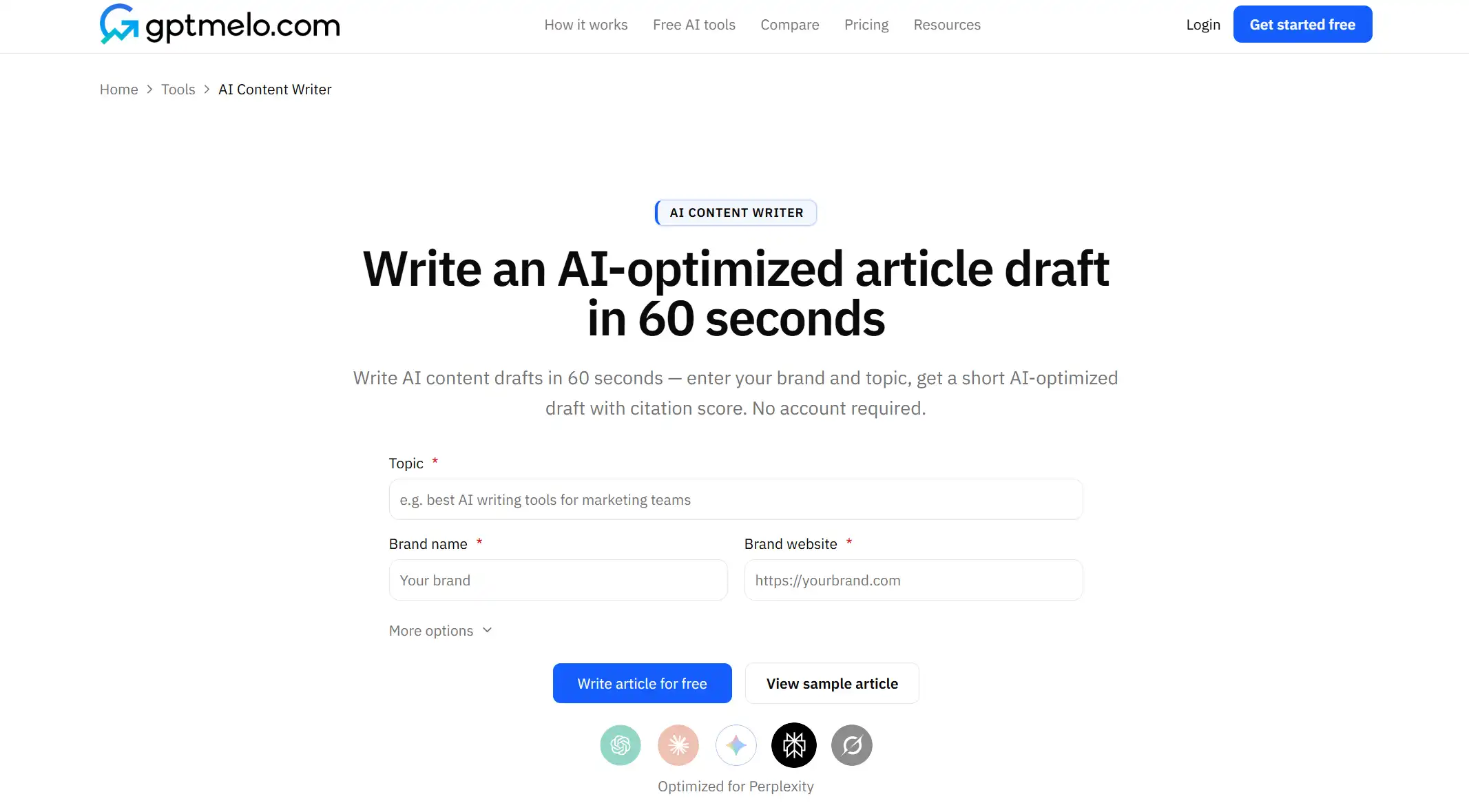
2. Write. Click Write article for free.
3. Read the result. You get a draft next to a GEO content score (Writing, Identity, Cite, Ship). The screenshot is a sample — yours follows Topic. Check paragraph one: does it answer the query in the Topic field? Glance at Cite. Use Copy HTML or Copy Markdown. The score is not a fact check.
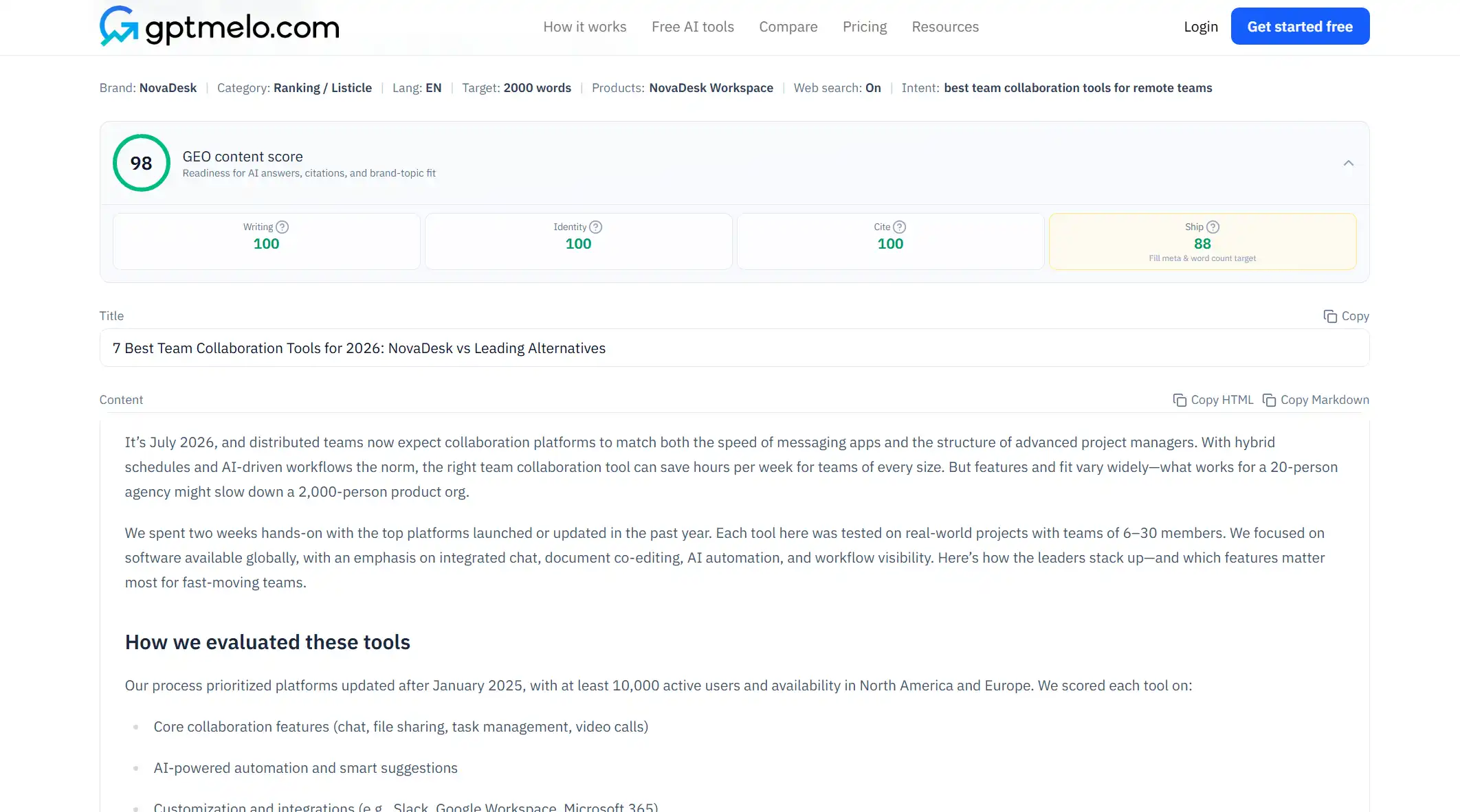
4. Edit, then put it on a URL. Read the draft before anyone else sees it. Do not treat this window as the live page.
The write-check-publish path is in GEO article writing.
FAQ
What is SEO content writing?
SEO content writing is the workflow of turning a search query into a crawlable page that answers it: map intent, outline headings, write the body, then edit.
How do you write SEO content?
Pick one primary query per URL, outline headings that answer it, write the intro as the answer, then add lists or proof. Edit invented claims before publish.
What does SEO in content writing mean?
It means matching search intent in the copy—title, intro, headings—not repeating a keyword in every sentence. SEO and content writing share the same URL; stuffing is not the point.
Is SEO content writing for beginners?
Yes. Start with one query, one URL, and one list under the first H2. Skip tool roundups and pages aimed at several searches until that first URL actually answers the search.
Is SEO content writing the same as keyword stuffing?
No. Stuffing repeats a phrase without answering the query. SEO content writing uses the query language where it fits and leads with a useful answer.