AI Content Writing Style Guidelines: Voice, Facts, Structure
Key takeaways
- AI content writing style guidelines are the voice, fact, and structure rules you paste before you generate—and use again when you edit.
- They are not a detector trick. Scores are hints. Usefulness and sourced claims are the reason to hit publish.
- After the draft exists, run GEO Content Checker on the page; fix intros and lists before you polish how it sounds.
AI content writing style guidelines are the rules you paste before a model drafts, and the same rules you use when you edit: voice, facts, and structure a reader can follow. They are not a trick to hide that ChatGPT helped. They are not a detector score.
| Situation | I’d start here | Skip if |
|---|---|---|
| You are about to prompt ChatGPT | Paste the brief, then these rules | You type “write content” with no reader |
| You have a fluent dump already | Structure check, then voice | You only wanted a detector score |
| You are writing team rules | Use the table below as what you paste | You needed a fill-in brief |
| The draft still invents numbers | Fix the facts before any style edit | You polish tone on unsourced claims |
What AI content writing style guidelines are
Style guidelines for AI content writing are a short list a model can follow in one go. They sit next to the brief. The brief names the reader and the point—use the content writing brief template. The guidelines name how the sentences should read.
They cover:
- Opening — the point in the first paragraph, not brand history
- Facts — names, limits, and numbers that exist, with a source or deleted
- Structure — headings, lists, or a small table a reader can scan
- Voice — varied sentence length; no empty adjectives (robust, seamless, landscape)
- Do not — keyword stuffing, detector tricks, or “write for everyone”
Paste this block with the brief:
| Rule | Tell the model |
|---|---|
| Opening | State the point in paragraph one. No company history first. |
| Facts | Use only the facts I paste. Delete any number I did not give you. |
| Structure | Use headings a reader would look for. Prefer a short list over a long mixed paragraph. |
| Voice | Vary sentence length. Do not use robust, seamless, or landscape unless they are a product name. |
| Do not | Do not stuff keywords. Do not write to pass a detector. Do not write for everyone. |
Outline-first prompts still help. Those live in ChatGPT for content generation. Tips that finish a useful page live in content writing tips. This article is the style list you paste.
Voice rules
Write as a person who has to ship the page, not as a brochure.
- Vary sentence length. Do not stack five sentences that all run the same length.
- Prefer concrete nouns and verbs. Cut “leverage,” “robust,” and “seamless” unless they are in a product name.
- Do not open every section with the same template line.
- Do not add “Furthermore” and “In conclusion” as decoration.
- Read a paragraph aloud. If you cannot retell the point, the reader cannot either.
If the outline is right and only the rhythm is stiff, a readability rewrite can wait until the facts are checked. That rewrite is AI humanizer—clarity, not a detector game.
Fact rules
Style cannot fix a fake number.
- Every number a reader might act on needs a source, or you delete it.
- Product names, plan limits, and paths (Settings → Members) must match the live product.
- Do not invent a study, a percentage, or a customer quote.
- If the model hedges (“typically,” “often”) around a fact you have, replace the hedge with the fact.
Paste verified facts in the prompt. If you do not have them, get them before you generate. A human still checks the draft. For that edit, see edit AI content.
Structure rules
A fluent wall of prose is not a useful page.
- Put the answer in the first paragraph.
- Use headings the reader would look for.
- Prefer a short list or a complete table over a 200-word paragraph of mixed claims.
- Keep one idea per section.
- If a section does not serve the point, cut it before you polish the adjectives.
Structure edits after a draft exists are in AI content optimization. Do that before you polish the voice. The live page still has to be crawlable. Fluent chat text in a doc is not the page.
What these guidelines are not
Skip this list (and this method) when you wanted:
- A detector workaround. Scores are hints. They are not the reason to hit publish.
- A fill-in brief. Reader and point come first; this article is how the sentences should read.
- A full how-to for spotting AI patterns in a finished draft. These rules try to stop the junk before the draft starts.
- A promise that AI content will rank. Useful, sourced, crawlable pages still have to exist.
Google’s helpful-content guidance still applies: write for people first, on pages search systems can fetch.
Common mistakes
- Pasting style rules with no reader and no point
- Treating a detector score as the reason to hit publish
- Polishing tone while numbers stay unsourced
- Opening every heading with the same template sentence
- Stuffing keywords into headings and calling it style
- Skipping a structure check because the draft “sounds human”
- Shipping the chat thread with no headings and no sources
Free check: voice, facts, and structure
Open gptmelo’s GEO Content Checker. Paste a page that should keep voice — the live article, not the style-rules doc. No account required.
1. Fill the form. Keep From URL selected and paste that live page. Switch to Paste content only if fetch is blocked.
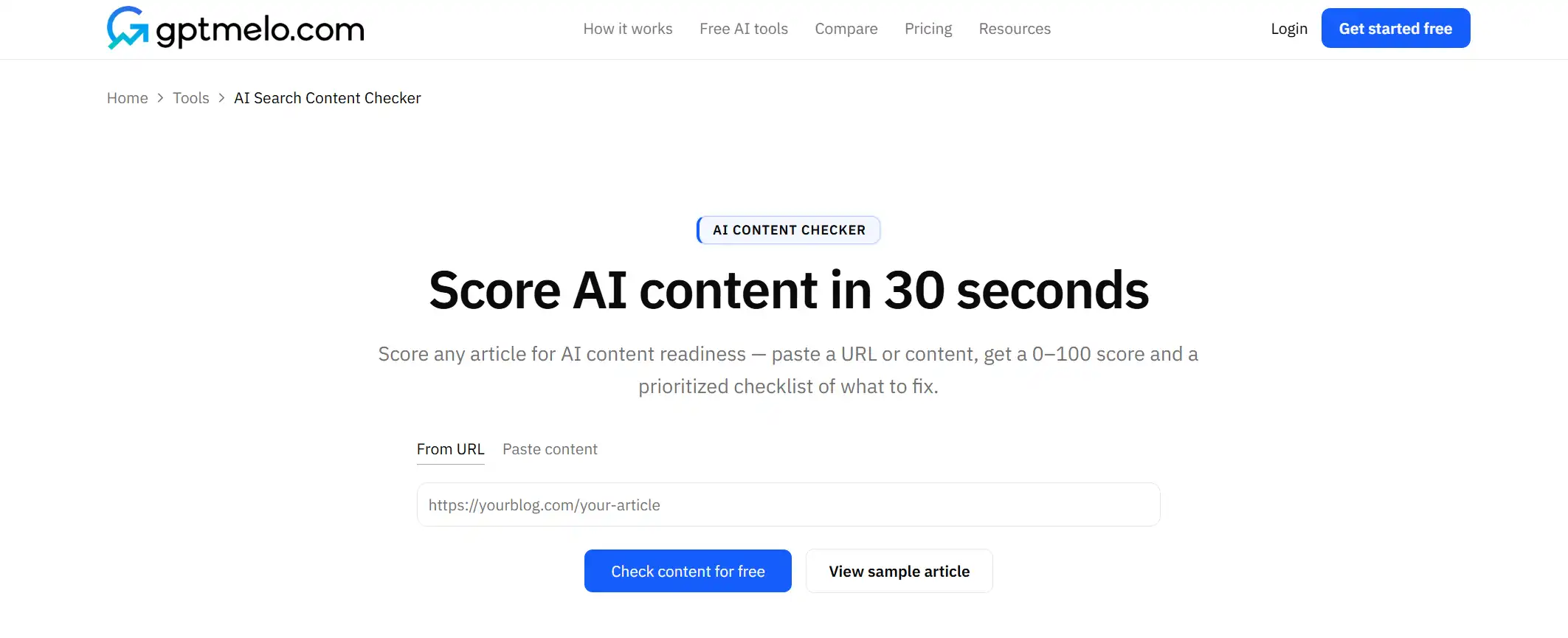
2. Check. Click Check content for free.
3. Read the result. You get a score plus pass/warn/fail rows (topic clarity, brand fit, readability, structure, quotable blocks). The screenshot is a sample — yours follows the URL you pasted. Glance at brand fit — does it still sound like you? The score is not a ranking guarantee.

4. Fix the live page, then check again. Edit the HTML people and models actually fetch. Do not treat this window as the page.
FAQ
What are AI content writing style guidelines?
A short set of rules for AI-assisted drafts: state the point early, keep sourced facts, use lists or tables a reader can scan, and vary sentence length. They go into the prompt and into the edit. They are not a way to hide that a model helped.
How do you write AI content writing style guidelines?
Write rules a model can follow in one go: opening, facts, format, voice, and what not to do (empty adjectives, unsourced numbers, detector tricks). Paste them with the brief. Then check the live page.
Do style guidelines make AI writing undetectable?
No. Guidelines make the page useful. Detector scores are editing hints, not the reason to hit publish. Do not rewrite only to change a detector score.
Should I paste guidelines before or after the brief?
Fill the brief first (reader and point), then paste the style rules, then generate. Empty “write content” prompts ignore both.
Do I still need a human edit?
Yes. Guidelines reduce junk. A person still checks names, numbers, and whether the opening answers the reader. Then run a structure check on the page.