Blog Writing Tips: Title, Opening Answer, Then Headings
Key takeaways
- Blog writing tips that work finish one post: a named reader, a title that keeps its promise, and headings they can scan.
- Writing a blog post is not a diary, not homework, and not a year of unpublished titles.
- Fill a short brief, draft in GEO Content Writer, then edit facts before you publish.
Blog writing tips only help if they finish a post a named reader can use. Tips for blog writing that say “be authentic” and “post often” do not. Writing a blog post starts with one reader and one point in the title. Writing blogs is repeating that, not filling a calendar with empty drafts.
| When | I’d prioritize | Skip if |
|---|---|---|
| You need to ship one post this week | The tips below, in order | You wanted a heading outline first |
| You still need tips for any useful page | Content writing tips first | You already know this is a blog post |
| You have a fluent ChatGPT dump | Fill the brief, then edit | You type “write a blog” with no reader |
| You were assigned a school blog entry | Skip this page | You needed a public post a stranger can use |
Pick one reader and one post
A blog post makes one promise. Name the reader in one sentence. Name what they can do or know when they finish. If you cannot, you are not ready to write the title.
Weak title: “Thoughts on productivity.”
Strong title: “How to back up photos from your phone before you switch.”
The strong title already states the post. The weak title makes the reader guess. Fill those two sentences in the content writing brief template before you draft. Content writing tips still apply. This article is the blog version: title, first paragraph, headings, publish.
Do not write for “everyone who visits the blog.” That person does not exist.
Writing a blog post
Writing a blog post is not typing until you feel done. It is keeping the title’s promise in the first paragraph, then answering the next questions as headings.
Do this:
- Title — the point, in the reader’s words. Not a clever tease that hides the topic.
- First paragraph — the answer. History, origin story, and “in this post I will” wait.
- Headings — the questions they would ask next, in order.
- Proof — steps, one example, or a source for any number they might act on.
- Cut — any section that does not serve the title.
Weak opening: “Phones have changed how we store memories, and technology continues to evolve.”
Strong opening: “To back up photos before you switch phones, copy them to a computer or a cloud album first—then check that the count matches before you wipe the old device.”
If the post is long enough to be an article with sections, how to write that piece is in article writing. If it also has to rank for one search query, use article writing for SEO.
If you draft in ChatGPT, paste the reader, the point, and the title first. Outline-first prompts are in ChatGPT for content generation. “Write a blog” with no reader produces a fluent dump you will rebuild.
Writing blogs people finish
Writing blogs over time is the same kind of writing on the next post. Finish this post. Publish it. Then pick the next reader and point. A wall of unpublished titles is not a blog.
Keep it simple:
- One post in progress
- One post you can name as next
- No third draft sitting unfinished
Cadence is optional. Clarity is not. A monthly post with a point in paragraph one beats five empty updates that never state what changed.
If the piece is actually an ad, stop. That is copywriting. The difference is in copywriting vs content writing. A heading outline for a post is a different task from these tips—fill the brief first, then outline. Do not start with headings and guess the reader.
For AI-assisted drafts, paste style rules after the brief. Those live in AI content writing style guidelines.
What blog writing is not
Skip these tips when you are writing:
- A school blog entry aimed at a rubric
- A diary with no reader and no point
- A feature dump that never states what to do
- A slogan or a trial button with no post
- A help doc that belongs inside a product, not on a public URL—see SaaS content writing if that is the real task
Homework prompts and journal papers have their own rules. Forcing them into “blog writing tips” produces a hybrid nobody asked for.
Edit then publish
Read the draft as the person you named. If you cannot retell the point aloud, they cannot either.
Cut filler. Cut the section that only exists because you had more to say. Keep numbered steps when the post is a how-to. Keep one example when it is an explainer.
If the post also has to rank, put the answer in the first paragraph and use searcher words where they fit. How to write that body is in SEO content writing. Do not stuff headings.
For a human edit after a model draft, see edit AI content.
Common mistakes
- Collecting tips instead of finishing one post
- Writing for everyone who visits the blog
- Starting with history instead of the point
- Treating a homework blog entry as a public post
- Pasting a fluent ChatGPT dump with no point in the title
- Opening five drafts and publishing none
- Measuring the blog by post count instead of whether a stranger can use the last post
Free check: the title and the opening answer
Open gptmelo’s GEO Content Writer. Draft the title plus the opening answer — not a pile of headings with no answer. No account required.
1. Fill the form. Topic is that title and the first-paragraph answer (what the reader can do when they finish). Brand name and Brand website are the blog that will publish this post. Open More options only if you need them.
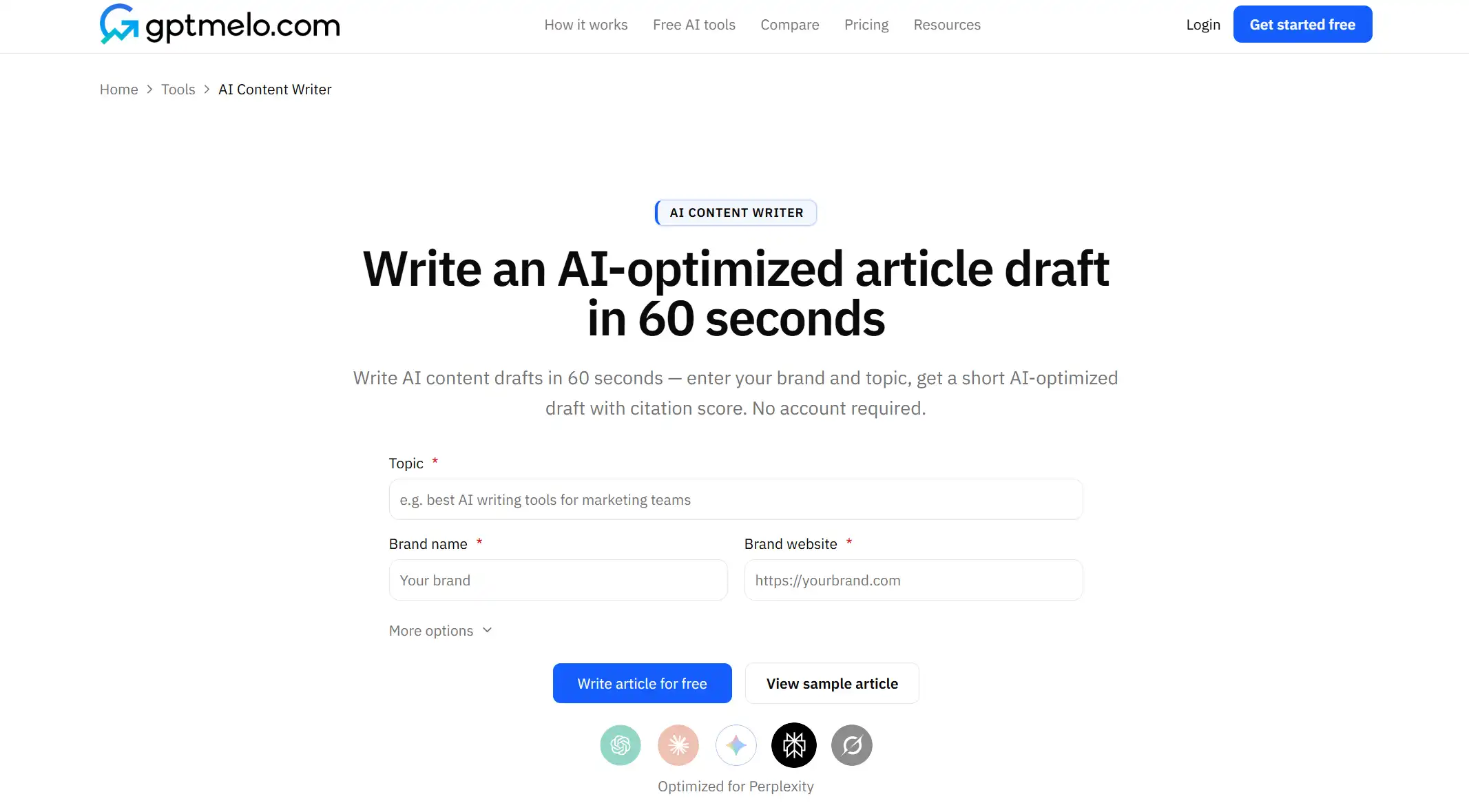
2. Write. Click Write article for free.
3. Read the result. You get a draft next to a GEO content score (Writing, Identity, Cite, Ship). The screenshot is a sample — yours follows Topic. Check paragraph one: does it keep the title’s promise? Glance at Writing. Use Copy HTML or Copy Markdown. The score is not a fact check.
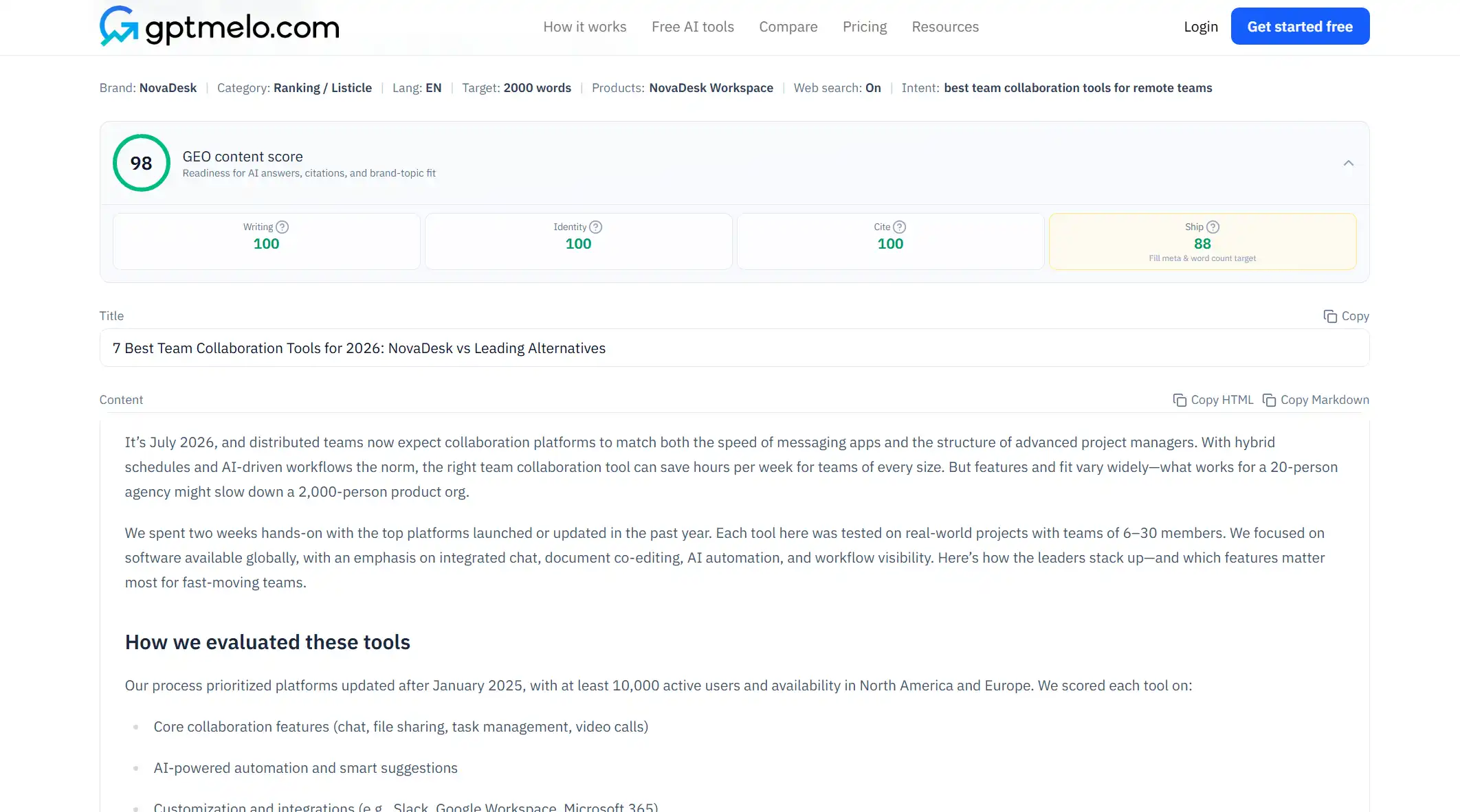
4. Edit, then put it on a URL. Read the draft before anyone else sees it. Do not treat this window as the live page.
The write-check-publish path is in GEO article writing.
FAQ
What are blog writing tips that actually help?
Name the reader, put the point in the title and the first paragraph, use headings they would look for, and publish a finished post. A list of “be consistent” tips does not finish the post.
How do you start writing a blog post?
Write one sentence for the reader and one for the point. Then write the title as that point. Then draft. Do not start with a blank page and a keyword list.
What are tips for blog writing vs content writing?
Content writing covers help docs, emails, and articles. Blog writing tips are for a public post: title, opening, headings, one promise. Tips for any useful page still apply.
Does writing blogs mean posting every day?
No. Writing blogs well means finishing posts a reader can use. A daily cadence with empty openings is worse than one clear post this week.
Is a homework blog entry the same as writing a blog post?
No. A school blog entry aims at a rubric. A public blog post aims at a reader who came to finish a task or understand a topic. This article is about the public post.